
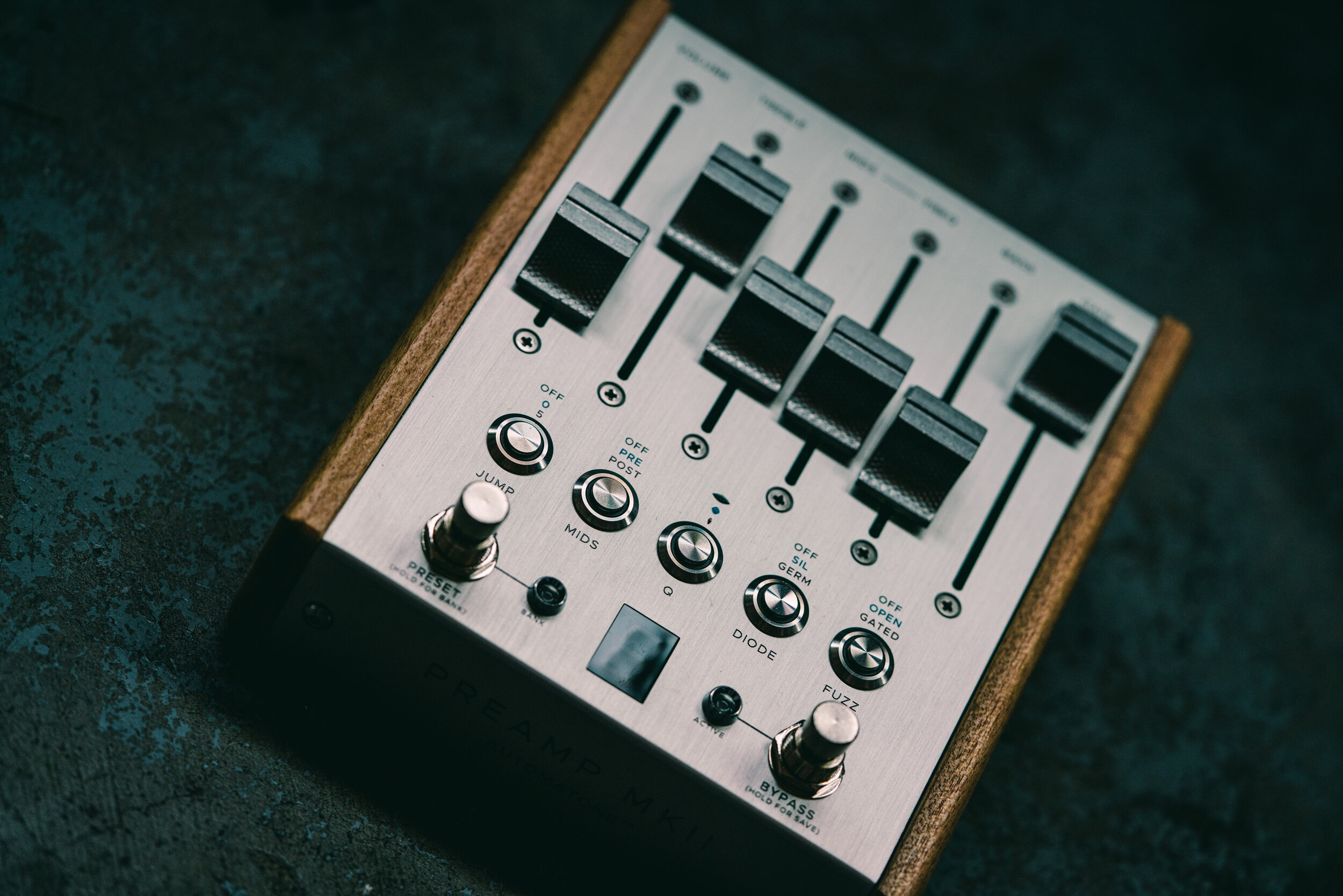

Boss RE-2 Space Echo
Don't overlook the little brother. The Boss RE-2 Space Echo packs the complete sonic character of the Roland RE-201 into a compact pedal — and this demo is the argument for taking it as seriously as the RE-202. Welcome back to Edge of Breakup.
In this episode the Boss RE-2 Space Echo (with preamp ON) takes center stage — running in the effects loop of my Benson Amps Vincent, with my Prisma Guitars Sunset loaded with Lollar Gold Foil pickups and Mastery Bridge and Trem. Watch for the companion demo with preamp OFF.
The Roland RE-201 Space Echo was the definitive tape echo unit of the 1970s — three tape heads, a built-in spring reverb tank, and a warm, saturated preamp character that made it the secret weapon of studios worldwide. Boss engineers analyzed multiple vintage RE-201 units, including a pristine example from the Boss and Roland factory archive, modeling every element: the tape path, record/playback mechanism, motor variations, preamp coloration, spring reverb character, and the gradual pitch change that occurs when you adjust the Repeat Rate.
The RE-2 fits all of that into Boss's classic compact format. Three dual concentric knobs cover six parameters: Echo Level and Reverb Level, Intensity and Tone, Repeat Rate and Wow & Flutter. A rotary 11-position mode selector dials in different virtual tape head configurations — modes 1-4 are echo only, modes 5-11 add the classic RE-201 spring reverb. The Wow & Flutter control is the key to the pedal's authenticity — it introduces the motor speed fluctuations and tape friction variations that give the original its organic, never-quite-mechanical character. Hold the footswitch for tap tempo or trigger the momentary Twist effect.
Preamp on or off is a meaningful choice: with the preamp engaged you get the warm, fat, compressed RE-201 character on the dry signal. With it off the dry signal is unprocessed analog. Today is preamp ON — the full RE-201 experience.
Stereo I/O, carryover/trails switch on the rear panel, battery or PSU powered.
🎛️ Boss RE-2 Space Echo: https://www.boss.info/global/products/re-2/
🎸 Prisma Guitars Sunset: https://www.prismaguitars.com/collections
🎸 Lollar Gold Foil Pickups: https://www.lollarguitars.com/gold-foil
🔊 Benson Amps Vincent: https://www.bensonamps.com/amps/vincent
Subscribe for more boutique tone explorations.
🎸 Prisma Guitars Sunset | Lollar Gold Foil Pickups | Mastery Bridge & Trem
🎛️ Boss RE-2 Space Echo | 11 Echo Modes | Preamp ON
🔊 Benson Amps Vincent (Effects Loop)
Recording: Universal Audio Apollo x4 | Royer R121 & SM57 on cab | Royer R10 on room
Cunningham Amps ZONK MKI Fuzz — Lost in Crystal Canyons
Two of the rarest circuits of the 1965 British Fuzz Boom — a Tone Bender MKI and a Zonk Machine — matched NOS germanium throughout, in single-digit production runs. Welcome back to Edge of Breakup.
In this episode the Lost in Crystal Canyons x Cunningham Amps ZONK | MKI takes center stage — running into my Frank Brothers Arcade goldtop with Lollar '50s Wind P90 pickups, Bigsby and Emerson Custom Treble Bleed, into my Benson Amps Vincent with Boss Waza Tube Amp Expander for reverb.
The story behind both circuits: In 1965, Gary Hurst of Sola Sound took a Gibson Maestro Fuzz-Tone to a three-transistor germanium design with more sustain and bite, launching the Tone Bender MKI. It made instant converts of The Beatles, Jeff Beck, Pete Townshend, and Mick Ronson. Almost simultaneously, John Hornby Skewes — operating out of Leeds — produced the Zonk Machine, a three-transistor germanium circuit closely related to the MKI Tone Bender. Two circuits from the same cultural moment, built on the same Germanic transistors, with subtly different characters. Both are among the rarest and most sought-after vintage fuzzes in existence.
Tim Cunningham of Cunningham Amps — building by hand in Auckland, New Zealand — matched the NOS germanium parts for this collaboration specifically. Robert Hart of Lost in Crystal Canyons brought the aesthetic: minimalist, classic rock period design, solid steel enclosure, NOS knobs, high quality switches, retro colorway. Each release drops in single-digit quantities.
The ZONK | MKI has exactly what it needs and nothing it doesn't. Two knobs: Fuzz (left, gain) and Level (right, overall output). Two switches: one kills the battery circuit so you can leave the pedal wired to your board safely, the other toggles between the Zonk Machine (left position) and Tone Bender MKI (right position). The two circuits clean up extraordinarily from the guitar volume, respond differently to pickup selection, and have distinctly different characters at every gain setting — you'll hear both in detail in this video.
Robert Hart: https://www.instagram.com/lostincrystalcanyons/
Tim Cunningham: https://www.instagram.com/cunninghamamps/
🎸 Frank Brothers Arcade | Lollar '50s Wind P90s | Bigsby | Emerson Custom Treble Bleed
🔊 Benson Amps Vincent: https://www.bensonamps.com/amps/vincent
Subscribe for more boutique tone explorations.
🎸 Frank Brothers Arcade Goldtop | Lollar '50s Wind P90 Pickups | Bigsby | Emerson Custom Treble Bleed
🎛️ Lost in Crystal Canyons x Cunningham Amps ZONK | MKI | NOS Germanium | Zonk Machine + Tone Bender MKI
🔊 Benson Amps Vincent
Recording: Royer R121 & SM57 on cab | Royer R10 on room | Universal Audio Apollo x4
Chase Bliss Gravitas Tremolo
The Chase Bliss Gravitas Analog Tremolo is end of life — which makes now the time to track one down. This one is absolutely worth hunting for on the used market. Welcome back to Edge of Breakup.
In this episode the Chase Bliss Gravitas takes center stage, running into my Benson Amps Vincent on both clean and dirt channels. Stratocaster with Lollar Pickups throughout.
The Gravitas is built around a fundamental design philosophy that Chase Bliss has refined across their entire lineup: the guitar signal stays 100% analog from input to output, while every knob and switch is connected to a digital brain that offers control depth impossible in a purely analog circuit. The first thing your signal hits is a discrete Class A clean boost — transparent and gorgeous. From there: Analog Devices AD823 op-amps for buffering and tone shaping, followed by the tremolo circuit itself.
Three core tremolo voices at its heart. Standard vintage opto-style amplitude tremolo — the classic '50s and '60s tube amp volume modulation. Harmonic tremolo, inspired by the 1961 Brownface Fender Twin — where the signal is split into high and low frequency bands, each modulated out of phase, creating a richer and more complex tremolo character than simple amplitude modulation can produce. And a combination of both simultaneously, running at whatever rates and depths you choose independently.
Then the Ramp knob and the dipswitch array on the top face unlock everything else. The Ramp control acts as a transparent clean boost when no dipswitches are engaged. Assign any of the five parameters — Tone, Rate, Depth, Sway, Volume — to the Ramp via dipswitch, and that parameter oscillates continuously at the rate set by the Ramp knob, independent of the main Rate control. Oscillating the Tone knob with Depth at zero kills the amplitude tremolo and leaves only a harmonic tremolo effect — all from the same pedal, with no separate circuit needed. Combine both simultaneously at different rates and you're deep into territory no other analog tremolo has explored.
Controls: Drive/Ramp, Volume, Tone, Rate, Depth, Sway. Tap tempo with subdivisions. Preset storage. MIDI, CV, and expression pedal connectivity.
This pedal is discontinued. Find one while you can.
🔍 Search for the Chase Bliss Gravitas on Reverb: https://reverb.com/marketplace?query=chase+bliss+gravitas
🔊 Benson Amps Vincent: https://www.bensonamps.com/amps/vincent
🎸 Lollar Pickups: https://www.lollarguitars.com
Subscribe for more boutique tone explorations.
🎸 Stratocaster | Lollar Pickups
🎛️ Chase Bliss Audio Gravitas | Analog Tremolo | Harmonic Tremolo | Ramp | Dipswitches
🔊 Benson Amps Vincent
Horrothia Effects Berkeley Uni-Vibe
A vintage Uni-Vibe signal path, four hand-matched Vactrols, three internal trim pots, an expression input, and a boost circuit — all in a pedalboard-friendly enclosure with design worth actually looking at. Welcome back to Edge of Breakup.
In this episode the Horrothia Effects Berkeley Uni-Vibe takes center stage — stacked with the Mythos Pedals High Road Fuzz (Joey Landreth Signature), into my Benson Amps Vincent on both clean and dirt channels. Stratocaster with Lollar Pickups throughout.
The original Shin-Ei Uni-Vibe was designed in 1968 by Fumio Mieda — a four-stage phaser built around a single incandescent bulb surrounded by four light-dependent resistors arranged in a cloverleaf configuration. As the bulb pulsed at the rate set by the LFO, it modulated all four resistors simultaneously, creating an asymmetric, reverse-sawtooth waveform that produced the thick, swirling throb associated with Hendrix at Woodstock, Gilmour on Breathe, and Robin Trower on Bridge of Sighs. That circuit, with its quirks and non-linearities, is the target.
Tom Oakes of Horrothia Effects built the Berkeley to be as close to that signal path as possible, while solving the original's reliability problems. In his own words: "Carbon film resistors, Mylar caps, transistors... Some small key changes have been made in line with mods done in the late '60s to open up the low-end and add more liquid movement." Where the original used a bulb, the Berkeley uses four hand-chosen Vactrols — photocells matched one by one in a custom test fixture to sit within a defined sweet spot. No guessing.
Controls on the face: Intensity, Rate, a Chorus/Vibrato toggle, a Level knob for the integrated boost circuit, and a 1/8" TRS expression input for real-time Rate control. Inside the enclosure, three trim pots allow deep customization: phase notch depth, impedance, and voicing from vintage to modern character. We go through all three in the video.
The Mythos Pedals High Road Fuzz is Joey Landreth's signature — a high-biased silicon fuzz designed for focus, immediacy, and the kind of attack that interacts beautifully with a vibe circuit in either order in the chain.
Speaker and instrument cables by Caulfield Cables — use code "EOB" for a discount: https://www.instagram.com/caulfieldcables/
🎛️ Horrothia Effects Berkeley Uni-Vibe: https://www.horrothia.com/berkeley
🎛️ Mythos Pedals High Road Fuzz: https://mythospedals.com
🎸 Lollar Pickups: https://www.lollarguitars.com
🔊 Benson Amps Vincent: https://www.bensonamps.com/amps/vincent
Subscribe for more boutique tone explorations.
🎸 Stratocaster | Lollar Pickups
🎛️ Horrothia Effects Berkeley | Uni-Vibe | 4 Matched Vactrols | Boost Circuit | Expression
🎛️ Mythos Pedals High Road Fuzz | Joey Landreth Signature | Silicon
🔊 Benson Amps Vincent
In the words of the creator, Tom Oakes: "Carbon film resistors, Mylar caps, transistors... Some small key changes have been made in line with mods that were done in the late 60’s to open up the low-end and add more liquid movement. There are 4 photocells, but no bulb. Hand chosen Vactrols are matched one by one in a custom test fixture to make sure that every component works within a well defined ‘sweet spot’ range. No guessing here."
Jam Pedals Delay Llama Xtreme
JAM Pedals has made the perfect analog delay. That's a strong claim. This video is the argument for it. Welcome back to Edge of Breakup.
In this episode the JAM Pedals Delay Llama Xtreme takes center stage — running in the effects loop of my Benson Amps Vincent, paired with the JAM Pedals Rattler for distortion, with my Prisma Guitars Sunset loaded with Lollar Gold Foil pickups.
The Delay Llama Xtreme is JAM's evolution of their beloved Delay Llama MK.3, adding a suite of features that earn the name. At its core: a fully analog bucket-brigade delay built around three replica Panasonic MN3205 BBD chips — up to 800ms of warm, characterful, tape-inspired analog repeats. Tap tempo with eighth, quarter, and dotted eighth note subdivisions. Four saveable user presets. Kill-dry switch. Trails/buffered bypass OR true bypass, selectable. Delay time expression pedal and CV input. Remote tap tempo and remote preset selection inputs. Hold the tap footswitch and the pedal self-oscillates for as long as you hold it. This is the most feature-complete analog delay pedal available at any price.
Then there are the four Xtreme modes — accessible via a prolonged press on the middle footswitch — which is where the Delay Llama stops being a delay pedal and becomes something genuinely new:
Vibrato — sine-wave LFO modulation applied to the delay trail, with dedicated Depth and Speed controls. Rich, disorienting, musical.
Tape-Age — emulates the slight random pitch variations and warble of a physical worn-down tape in a vintage tape echo machine. Frequency of deviation is controllable. This is what tape delay actually sounds like when it's lived a full life.
Random — randomly changes the millisecond value of the repeats over fixed time increments, producing abrupt pitch and rhythmic changes that sound simultaneously chaotic and musical.
Pitch-Shift — five distinct pitch-shifted intervals and five playback patterns, including a 5-mode sequencer. An entirely different instrument.
The JAM Pedals Rattler — NOS LM308N chip, asymmetrical clipping, carbon comp resistors — stacks beautifully with the Llama Xtreme in the effects loop. The combination of analog delay and a RAT-style circuit into a pushed Benson clean channel is exactly what it sounds like.
🎛️ JAM Pedals Delay Llama Xtreme: https://jampedals.com/shop/delay-llama-xtreme/
🎛️ JAM Pedals Rattler: https://jampedals.com/shop/rattler/
🎸 Prisma Guitars Sunset: https://www.prismaguitars.com/collections
🎸 Lollar Gold Foil Pickups: https://www.lollarguitars.com/gold-foil
🔊 Benson Amps Vincent: https://www.bensonamps.com/amps/vincent
Subscribe for more boutique tone explorations.
🎸 Prisma Guitars Sunset | Lollar Gold Foil Pickups
🎛️ JAM Pedals Delay Llama Xtreme | 800ms BBD Analog Delay | Tap Tempo | 4 Xtreme Modes
🎛️ JAM Pedals Rattler | NOS LM308N
🔊 Benson Amps Vincent (Effects Loop)
Thorpy FX Deep Oggin
Chorus gets a bad reputation. Too much 80s rock association, too much wash, not enough character. The ThorpyFX Deep Oggin exists to change that — and it has. Welcome back to Edge of Breakup.
In this episode the ThorpyFX Deep Oggin takes center stage — running into my Nash Guitars JM63 Jazzmaster with Lollar Pickups, into my Benson Amps Vincent.
The Deep Oggin is a collaboration between ThorpyFX founder Adrian Thorpe MBE and Dan Coggins — formerly of Lovetone, one of the most revered boutique pedal companies in history. Coggins designed the Lovetone Meatball, the Brown Source, the Doppelganger, the Ring Stinger (heard on Radiohead's Kid A), and others before Lovetone closed its doors in 2000. The Deep Oggin is his first modulation circuit since those days, and it was worth the wait.
The circuit is 100% analog, built around NOS BBD chips — the same bucket-brigade delay chip technology that gives vintage chorus pedals their lush, three-dimensional, organic character. The components are immaculate: 1% metal film resistors, Wima and Panasonic capacitors, Neutrik jacks, Burr-Brown op-amps. Powder-coated steel and stainless steel laser-cut enclosure. This is ThorpyFX's standard — no shortcuts.
Five controls. Depth and Rate shape the intensity and speed of the modulation. Volume and Treble allow level and brightness adjustment. The Blend knob is where the entire tonal palette lives: at minimum you're running fully dry through the pedal's preamp circuit; at maximum you're running fully wet — pure vibrato, pitch-shifting and disorienting in all the right ways. Anywhere in between is chorus — thick, chewy, analog chorus with that three-dimensional quality that digital chorus simply cannot replicate. The Blend knob is not a wet/dry mix in the conventional sense. It's a portal.
Dry and wet outputs for stereo operation — a significant feature for players who want to send chorus wet signal to one amp and dry to another.
🎛️ ThorpyFX Deep Oggin: https://thorpyfx.com/products/the-deep-oggin-chorus-vibrato
🎸 Nash Guitars JM63 Jazzmaster: https://nashguitarsusa.com
🎸 Lollar Pickups: https://www.lollarguitars.com
🔊 Benson Amps Vincent: https://www.bensonamps.com/amps/vincent
Subscribe for more boutique tone explorations.
🎸 Nash Guitars JM63 Jazzmaster | Lollar Pickups
🎛️ ThorpyFX Deep Oggin | Analog Chorus/Vibrato | Dan Coggins x Adrian Thorpe | NOS BBD
🔊 Benson Amps Vincent
Recording: Universal Audio Apollo x4 | Royer R-121 & SM57 on 2x12" cab | Royer R10 on room
Acorn Amps Solid State
2,962 characters — under 5,000. Here's the full package:
What if your pedalboard had its own amp head? The Acorn Amps Solid State is exactly that — and I'm honored to help announce it. Welcome back to Edge of Breakup.
In this episode I'm running the Acorn Amps Solid State in both configurations: as a preamp/overdrive into the Benson Vincent, and direct to my Benson Amps 2x12" cabinet with Celestion G12H speakers. Guitar is my Nash S63 with Emerson Custom wiring kit, treble bleed, and a KingTone Switch in the secondary tone position.
The Solid State is a full circuit recreation of a famously overlooked low-wattage practice amp that was revealed in 2021 to be a secret studio weapon in the hands of players like Josh Homme — responsible for wiry, aggressive tones on guitar, bass, drums, and vocals. Acorn built it around the same TDA series Class-AB power amp device found in the original hardware, making it the most authentic reproduction possible in a modern pedal format. This is not an amp-in-a-box. This is an actual amp, in a box.
Two output jacks define the whole concept. The instrument-level output sends the signal into your normal pedal chain or amp input — Normal and Saturation modes, Low/Mid/High EQ, and a toggle switch to select whether the signal exits before or after the power amp circuit. This is the preamp/overdrive use case.
The speaker output is something else entirely. Run a speaker cable from that jack to any cab and the Solid State becomes a 10-watt amp head — no wall plug, no head, no rack. Powered by a Strymon Ojai R30 set to 18V from a single power port. Output scales by impedance: 10W into 4 ohms, 7.5W into 8 ohms, 6W into 16 ohms. I ran it at 16 ohms into the Benson 2x12" and the results are some of the most interesting guitar tones I've gotten all year.
The Boss Waza Tube Amp Expander is in the loop between the preamp out and the cabinet for reverb — and it works beautifully in that configuration.
Note: In the video I refer to Acorn as operating from Austin, Texas — they co-operate out of both Austin and Atlanta, Georgia. Apologies for the error.
Speaker and instrument cables by Caulfield Cables — use code "EOB" for 20% off.
🎛️ Acorn Amps Solid State: https://www.acornamps.com/gear/solid-state-amppreamp-pedal
🎸 Nash Guitars S63: https://nashguitarsusa.com
🔧 Emerson Custom Wiring Kit: https://emersoncustom.com
🔊 Benson Amps 2x12" Cabinet: https://www.bensonamps.com/amps/2x12-cabinet
Subscribe for more boutique tone explorations.
🎸 Nash S63 | Emerson Custom Wiring Kit & Treble Bleed | KingTone Switch
🎛️ Acorn Amps Solid State | 10W Amp/Preamp Pedal | Normal & Saturation Modes
🔊 Benson Amps Vincent (Amp-In Input) / Benson Amps 2x12" Cabinet with Celestion G12H (Direct)
Powered by: Strymon Ojai R30 at 18V
Walrus Audio Slotva
The coolest ambient reverb pedal I've ever played. Welcome back to Edge of Breakup.
In this episode the Walrus Audio Slötvå Multi Texture Reverb takes center stage — paired with my Nash S63 Stratocaster loaded with Lollar Vintage Blonde pickups and an Emerson Custom wiring kit, into my Benson Amps Vincent.
Also watch: Slötvå in a full band mix: https://youtu.be/vpUm0xyZslE
The Slötvå is an evolved version of Walrus Audio's celebrated Slö reverb, adding the ability to save three presets — a significant upgrade for live use. Three algorithms, six modulation wave shapes, and a set of momentary functions that transform it from a reverb pedal into a full ambient performance tool.
Dark — a deep, wide, nightmarish reverb with a -1 octave signal feeding the reverb trail. The X knob controls the level of that low octave, letting you dial in everything from subtle subterranean weight to a full low-octave doubling of every note. Aurally dizzying in the best possible way.
Rise — an auto-swell reverb for cinematic, breathing ambient textures. Notes play into silence and the reverb swells in from below rather than presenting itself immediately. The X knob controls the rise time — lower for shorter swells, higher for longer, more patient blooms. A stunning mode for clean playing.
Dream — a lush pad reverb with a latching function that is genuinely the most fun I've had with a reverb pedal. Press the Sustain switch once: the pedal captures and holds the current reverb decay indefinitely, creating a sustained pad you can play over for as long as you want. Press it again and the pad decrescendos according to the Decay knob setting. The X knob adds vibrato to the held pad. This is its own instrument.
Three modulation wave shapes selectable via secondary toggle function — Sine (smooth pitch up/down), Warp (asymmetric pitch-up, warped record character), and Sink (asymmetric pitch-down, Bigsby-style detune). Mix, Filter, and Depth controls shape and tame the reverb tail. Full wet — no dry signal — is a legitimate and beautiful way to run this pedal.
🎛️ Walrus Audio Slötvå: https://www.walrusaudio.com/products/slotva-multi-texture-reverb
🎸 Nash Guitars S63: https://nashguitarsusa.com
🎸 Lollar Vintage Blonde Pickups: https://www.lollarguitars.com
🔧 Emerson Custom Wiring Kit: https://emersoncustom.com
🔊 Benson Amps Vincent: https://www.bensonamps.com/amps/vincent
Subscribe for more boutique tone explorations.
🎸 Nash S63 Stratocaster | Lollar Vintage Blonde Pickups | Emerson Custom Wiring Kit
🎛️ Walrus Audio Slötvå Multi Texture Reverb | Dark / Rise / Dream
🔊 Benson Amps Vincent
Universal Audio Starlight
The most authentic tape, bucket-brigade, and digital delays ever placed into a stompbox — three iconic delay circuits from three different decades, all in one enclosure. Welcome back to Edge of Breakup.
In this episode the Universal Audio Starlight Echo Station takes center stage, running in the effects loop of my Benson Amps Vincent with my Prisma Guitars Sunset loaded with Lollar Gold Foil pickups.
UA built the Starlight around their dual-engine UAFX processing platform, and these are end-to-end circuit emulations, not approximations.
Tape EP-III — UA's complete circuit emulation of the early 1970s Echoplex EP-3 tape echo, the most beloved and sought-after tape delay in recorded music history. Every eccentric trait of the hardware is present: wow/flutter randomness, the sound of the tape splice, and the incredibly musical preamp circuit. Three tape age settings — New, Used, and Worn — shape the character of the repeats from clean and clear to saturated and weathered. Delay time: 80-700ms. Self-oscillates realistically at high feedback. This is not a simulation of a tape delay. It is a tape delay, running in a stompbox.
Analog DMM — bucket-brigade emulation based on the EHX Deluxe Memory Man, the vintage American bucket-brigade delay that defined studio echo in the 1970s and '80s. Syrupy repeats, thick modulation, and mind-bending textures. Delay time: 110-1068ms with pitch-shifting artifacts when delay time changes — just like the original hardware. Self-oscillates at high feedback.
Precision — UA's own studio-grade digital delay derived from the UAD plug-in library, emulating early 1980s rack-mount digital delay units. Pristine, transparent repeats with optional modulation. Delay time up to 1500ms. Will not self-oscillate — sustains indefinitely at max feedback without spiraling, which is the behavior of that actual circuit.
Cooper Time Cube — free at registration. Based on the truly obscure 1970s studio effect that generated delays via a coiled length of rubber garden hose. A spatial doubling effect that sits unlike any other delay in the pedal, up to 2500ms of delay time.
All four algorithms feature analog dry-through, spillover on bypass, tap tempo, preset storage, and true or buffered bypass selectable via the UAFX Control app.
This is the third demo in my UAFX series — check out the Astra Modulation Machine: https://www.youtube.com/watch?v=j6rPncQ6rww and the Golden Reverberator: https://www.youtube.com/watch?v=yiu8evGd-zc
🎛️ Universal Audio Starlight Echo Station: https://www.uaudio.com/products/starlight-echo-station
🎸 Prisma Guitars Sunset: https://www.prismaguitars.com/collections
🎸 Lollar Gold Foil Pickups: https://www.lollarguitars.com/gold-foil
🔊 Benson Amps Vincent: https://www.bensonamps.com/amps/vincent
Subscribe for more boutique tone explorations.
🎸 Prisma Guitars Sunset | Lollar Gold Foil Pickups
🎛️ Universal Audio Starlight Echo Station | Tape EP-III / Analog DMM / Precision / Cooper Time Cube
🔊 Benson Amps Vincent (Effects Loop)
Thorpy FX The Dane
Boost into overdrive is my favorite thing in guitar. And the Thorpy FX The Dane might be the most elegant execution of that idea I've found. Welcome back to Edge of Breakup.
In this episode, the Thorpy FX The Dane Boost/Overdrive takes center stage — running into my Nash Guitars T63 Telecaster loaded with Lollar Vintage Blonde neck and Lollar Special bridge pickups, wired with an Emerson Custom 4-Way Tele Wiring Kit and Treble Bleed, into my Benson Amps Vincent.
The Dane is the signature pedal of Peter "Danish Pete" Honoré, built to cover the full palette of his tones from pristine clean headroom to singing lead saturation in a single enclosure. Two sides, two footswitches, three distinct tonal states.
The right side is a high-headroom, super-clean boost — but crucially, not a simple volume push. The Lows control adds a targeted low-end boost that specifically addresses the thinness and spank that single-coil players hear when they hit a clean amp hard. Single coil into a clean amp can feel like it's missing body — The Dane's Lows control fills exactly that gap. The Boost and Lows knobs together transform the right side from a utility boost into a genuine tone-shaping preamp.
The left side is a complex light-to-medium gain overdrive — Volume, Drive, and Tone controls, toothy and purposeful with the kind of clarity that doesn't get clinical. Great on its own. But the routing design is the key to everything: the boost runs directly into the drive. When you engage both, the boost slams the front end of the overdrive circuit, dramatically changing the harmonic texture and dynamic responsiveness. Three distinct states: overdrive alone, boost alone, or boost into drive — the last of which produces full, fat sustain that somehow stays clear and pick-sensitive.
Built with Burr-Brown op-amps, Wima and Panasonic capacitors, Neutrik jacks, 1% metal film resistors, gold-plated PCB, and dust-sealed Alpha pots. The internals are as immaculate as the tones.
The boost-into-drive combination is also a substitute amp channel for players without attenuation. Set your overdrive as your core rhythm tone, and use the boost as an ignition switch — it's a second channel in a single compact enclosure. With attenuation? Park your amp on the edge of breakup and hit it with The Dane's boost — the results are spectacular.
🎛️ Thorpy FX The Dane: https://thorpyfx.com/products/the-dane
🎸 Nash Guitars T63 Telecaster: https://nashguitarsusa.com
🎸 Lollar Vintage Blonde & Special Bridge Pickups: https://www.lollarguitars.com
🔧 Emerson Custom 4-Way Tele Wiring Kit: https://emersoncustom.com
🔊 Benson Amps Vincent: https://www.bensonamps.com/amps/vincent
Subscribe for more boutique tone explorations.
🎸 Nash Guitars T63 Telecaster | Lollar Vintage Blonde (Neck) & Special Bridge | Emerson Custom 4-Way Wiring Kit & Treble Bleed
🎛️ Thorpy FX The Dane | Boost/Overdrive
🔊 Benson Amps Vincent
Lollar Pickups El Rayo Humbuckers
The humbucker hunt may be over. Episode 4 — the Lollar El Rayo Humbuckers in the Gibson SG Standard '61 Reissue, and they might just be the best humbucker I've ever played. Welcome back to Edge of Breakup.
Catch the full series here:
Stock Gibson Burstbuckers: https://youtu.be/xcC6wLci1DY
Seymour Duncan Antiquities: https://youtu.be/ntlHT09FXxA
Fralin Pure PAF: https://youtu.be/lPHmESPyyxs
The Lollar El Rayo is unlike any humbucker in Jason Lollar's lineup — designed specifically for single-coil players who want humbucker real estate without the humbucker compromises. The numbers tell the story: 3.5K DC at neck, 4.0K at bridge. These are extraordinarily low output figures for a humbucker — and they produce a percussive, articulate quality that sits closer to a single-coil pickup than any traditional PAF-style humbucker.
The design is deliberately unusual. Alnico 5 in the neck, Alnico 8 in the bridge — two completely different magnet materials creating two distinct voices within the same aesthetic. Specially formulated copper wire. A flat frequency response without the heavy mid-range bump that makes most humbuckers feel compressed and thick compared to single coils. Don't be fooled by the low DC numbers — the El Rayo has strong output and a meaty growl when pushed. It just doesn't compress and flatten when you dig in. Instead, you get clear distortion that stays articulate under high gain — exactly what a Gibson SG on a pushed amp wants from its pickups.
Premier Guitar called it a design that "effectively bridges single-coil and humbucker voices." That's exactly right. If you've spent your guitar life in Strat territory and always found humbuckers too dark, too compressed, or too lacking in note separation — this is the pickup that changes that.
The Gibson SG Standard '61 Reissue is now fully modded: Emerson Custom SG Wiring Kit, Emerson Custom Treble Bleeds on both volume knobs, StewMac bone nut and Locking Kluson Tuners, Callaham stainless steel stop tail, saddle, and bridge kit. The platform is sorted. Now the pickups are too.
🎸 Lollar El Rayo Humbuckers: https://www.lollarguitars.com/lollar-humbucker-pickups/el-rayo-humbucker
🔧 Emerson Custom SG Wiring Kit: https://emersoncustom.com
🔧 Callaham Stainless Steel Hardware: https://callahamguitars.com
🔧 StewMac Bone Nut & Locking Kluson Tuners: https://www.stewmac.com
Subscribe for more boutique tone explorations.
🎸 Gibson SG Standard '61 Reissue | Lollar El Rayo Humbuckers | Emerson Custom SG Wiring Kit & Treble Bleeds | Callaham Stainless Steel Hardware | StewMac Bone Nut & Locking Kluson Tuners
🔊 Benson Amps Vincent
Jam Pedals Rattler & Wahcko
In high school, the pedalboard was a ProCo Rat and a Crybaby Wah. In 2022, we're running the JAM Pedals Wahcko Custom Shop and JAM Pedals Rattler into a Benson Amps Vincent. The vibes are the same. Everything else is better. Welcome back to Edge of Breakup.
JAM Pedals in Athens, Greece sent over a package that triggered some serious nostalgia — and inspired a direct comparison between the gear I played at 17 and what that same idea sounds like when it's done right.
The Wahcko Custom Shop (Point-to-Point version) is as serious as a wah pedal gets. A red Fasel inductor, 0.5W carbon comp resistors, and tropical fish capacitors in a fully point-to-point hand-wired build with an ever-changing custom shop finish. The core Wahcko circuit features a bufferless proprietary design — meaning impedance-sensitive pedals, including germanium fuzz boxes, can sit after the Wahcko with no interaction issues. A 6-position rotary switch adjusts the frequency sweep range, giving you everything from a dark, vocal character to a bright, slicing peak. An internal trimmer adjusts input gain. Nile Rodgers, Steve Lukather, Richie Sambora, Bill Frisell, Sean Ono Lennon, and Dweezil Zappa are among those who've made the Wahcko a permanent fixture. There's a reason.
The JAM Pedals Rattler is a ProCo RAT-style distortion built around the NOS LM308N chip — the same chip found in the original early '80s RAT boxes that defined a generation of rock tone. Asymmetrical clipping circuit, carbon comp resistors, and years of R&D to make it more responsive to picking and fretting nuances than the original. The result is an open, dynamic, overdriven tube-amp character — fat, creamy sustain with genuine sensitivity to how you play. It looks like a piece of modern art and sounds nothing like the $49 Rat I had in high school.
Wah first, distortion second. That's the chain. Through my Frank Brothers Arcade loaded with Lollar P90 pickups, clean and dirty on the Benson Amps Vincent, this is exactly what 16-year-old me was reaching for and couldn't afford.
🎛️ JAM Pedals Wahcko: https://jampedals.com/shop/wahcko/
🎛️ JAM Pedals Rattler: https://jampedals.com/shop/rattler/
🔊 Benson Amps Vincent: https://www.bensonamps.com/amps/vincent
Subscribe for more boutique tone explorations.
🎸 Frank Brothers Arcade | Lollar P90 Pickups
🎛️ JAM Pedals Wahcko Custom Shop (Point-to-Point) | Tropical Fish Capacitors | Red Fasel Inductor
🎛️ JAM Pedals Rattler | NOS LM308N Chip
🔊 Benson Amps Vincent
Recording: Universal Audio Apollo x4 | Royer R121 & SM57 on cab grill | Royer R10 on room
Jam Pedals Ripply Fall
What happens when two of JAM's most beloved analog modulation pedals live in the same enclosure? You get the Ripply Fall — and it's been on my list for a long time. Welcome back to Edge of Breakup.
In this episode the JAM Pedals Ripply Fall takes center stage, running into my Frank Brothers Arcade with Lollar P90 pickups, through the Benson Amps Vincent on both its clean and dirt channels.
JAM Pedals built the Ripply Fall after years of recommending the WaterFall and the Ripple together as a natural pairing — eventually deciding the combination deserved its own dedicated enclosure. The result is a 100% analog, all-BBD dual modulation pedal handmade in Athens, Greece, with some unique features that make it more than just two pedals bolted together.
The left side is the WaterFall — JAM's smooth, lush-sounding Chorus/Vibrato circuit built around BBD chips. A toggle switches between Chorus and Vibrato modes, and a second toggle shifts to a wetter, more immersive effect character. Speed and Depth controls shape the movement.
The right side is the Ripple — JAM's smooth, sweet, transparent 2-stage phaser. A different sonic personality entirely — the Ripple adds a warm, organic sweep that sits underneath and behind your tone rather than in front of it.
The magic is in combining them. Both sides can run simultaneously for three-dimensional layered modulation that no single-effect pedal can approach — chorus or vibrato on top of a phaser sweep creates a depth and movement that makes your amp sound like it's breathing. A center footswitch triples the WaterFall's speed at any given moment, generating tones ranging from Leslie speaker simulation all the way to ring modulator effects and deranged warble. Two expression pedal inputs allow real-time control of WaterFall Depth and Speed independently.
Premier Guitar called it "lovely and truly musical individual and composite modulation effects" — and they're right.
🎛️ JAM Pedals Ripply Fall: https://jampedals.com/shop/ripply-fall/
🎸 Frank Brothers Arcade + Lollar P90s
🔊 Benson Amps Vincent: https://www.bensonamps.com/amps/vincent
Subscribe for more boutique tone explorations.
🎸 Frank Brothers Arcade | Lollar P90 Pickups
🎛️ JAM Pedals Ripply Fall | WaterFall Chorus/Vibrato + Ripple 2-Stage Phaser | BBD Analog
🔊 Benson Amps Vincent
Recording: Universal Audio Apollo x4 | Royer R121 & SM57 on cab grill | Royer R10 on room
Fralin Pure PAF Humbuckers
The humbucker hunt continues. Episode 3 — this time with the Lindy Fralin Pure PAF Humbuckers in a Gibson SG Standard '61 Reissue. Welcome back to Edge of Breakup.
Catch the previous episodes here:
Stock Gibson Burstbuckers: https://youtu.be/xcC6wLci1DY
Seymour Duncan Antiquities: https://youtu.be/ntlHT09FXxA
The Lindy Fralin Pure PAF is Lindy's personal favorite humbucker and his best-selling design — built in Richmond, Virginia to original 1950s Gibson PAF specifications with modern quality control and a 10-year warranty. USA-made Alnico 2 bar magnets, 42-gauge plain enamel wire, USA-made butyrate bobbins, and a compensated overwound bridge for even output across both positions. DC resistance runs 7.5K at neck and 8K at bridge. Every set is hand-wound using Fralin's proprietary "Sectioning" technique — a throwback to how the original Gibson workers wound their coils — giving each pickup a sweet, clear, layered tone that a machine-wound pickup simply cannot replicate.
The magnets are hand-weakened after winding to soften the treble and smooth the grind. The result is what Fralin describes as clean, articulate, and warm — pronounced pick attack, pure-sounding plain strings, and bright wound strings. These won't break up as early as a hot modern humbucker, which on a Gibson SG pushing a Benson Amps Vincent is exactly what you want: dynamics that respond to your hands rather than compressing before you get there.
The guitar is the Gibson SG Standard '61 Reissue, modded with an Emerson Custom SG Wiring Kit, Emerson Custom Treble Bleeds on both volume knobs, StewMac Locking Kluson Tuners, and a Callaham stainless steel stop tail, saddle, and bridge kit.
Still to come in the series: Lollar and Sonic pickups. Which one takes the crown?
🎸 Lindy Fralin Pure PAF Humbuckers: https://www.fralinpickups.com/product/pure-paf/
🔧 Emerson Custom SG Wiring Kit: https://emersoncustom.com
🔧 Callaham Stainless Steel Hardware: https://callahamguitars.com
🔧 StewMac Locking Kluson Tuners: https://www.stewmac.com
#FralinPickups #PurePAF #GibsonSG #HumbuckerHunt #PAFPickup #GibsonSG61 #HumbuckerPickups #PickupSwap #GibsonGuitar #EmersonCustom #Callaham #GuitarMod #GuitarTone #GuitarDemo #EdgeOfBreakup
Subscribe for more boutique tone explorations.
🎸 Gibson SG Standard '61 Reissue | Lindy Fralin Pure PAF Humbuckers | Emerson Custom SG Wiring Kit & Treble Bleeds | Callaham Stainless Steel Hardware | StewMac Locking Kluson Tuners
🔊 Benson Amps Vincent
Seymour Duncan Antiquities Humbuckers
The humbucker hunt continues. Episode 2 of the search for the best pickup for a Gibson SG Standard '61 Reissue — this time with the Seymour Duncan Antiquity Humbuckers. Welcome back to Edge of Breakup.
If you missed the baseline video with the stock Gibson Burstbuckers, find it here: https://youtu.be/xcC6wLci1DY
The Seymour Duncan Antiquity is one of the most historically committed PAF replicas on the market. Built in Seymour Duncan's Custom Shop "Antiquity room," each set is wound on Seymour's original Leesona 102 winding machine — purchased directly from the Gibson factory in Kalamazoo, Michigan, where Seth Lover wound the original Patent Applied For humbuckers in the mid-1950s. The butyrate bobbins are cast from the same factory mold used for the original Gibson PAF. 42AWG plain enamel mag-wire, 2.5-inch Alnico 2 bar magnet, nickel silver cover, maple spacer, and long-legged nickel silver bottom plate complete the build. DC resistance runs approximately 7.7K at the neck and 8.6K at the bridge. Not wax potted — by design — which preserves the edge-of-feedback harmonic character that made the originals so coveted. Every set is aged cosmetically and magnetically, then signed by Seymour on the magnet and bottom plate.
The result is warm, smooth, and harmonically rich — Alnico 2 producing that singing, slightly compressed character that cleans up beautifully from the guitar's volume knob and rewards pick dynamics with nuance rather than flatness.
The guitar is the Gibson SG Standard '61 Reissue, already modded with an Emerson Custom SG Wiring Kit, Emerson Custom Treble Bleeds on both volume knobs, StewMac Locking Kluson Tuners, and a Callaham stainless steel stop tail, saddle, and bridge kit.
Still to come in the series: Fralin, Lollar, and Sonic pickups. Which one wins? Follow along.
🎸 Seymour Duncan Antiquity Humbuckers: https://www.seymourduncan.com/single-product/antiquity-humbucker
🔧 Emerson Custom SG Wiring Kit: https://emersoncustom.com
🔧 Callaham Stainless Steel Hardware: https://callahamguitars.com
🔧 StewMac Locking Kluson Tuners: https://www.stewmac.com
#SeymoreDuncan #AntiquityHumbucker #GibsonSG #HumbuckerHunt #PAFPickup #GibsonSG61 #HumbuckerPickups #PickupSwap #GibsonGuitar #EmersonCustom #Callaham #GuitarMod #GuitarTone #GuitarDemo #EdgeOfBreakup
Subscribe for more boutique tone explorations.
🎸 Gibson SG Standard '61 Reissue | Seymour Duncan Antiquity Humbuckers | Emerson Custom SG Wiring Kit & Treble Bleeds | Callaham Stainless Steel Hardware | StewMac Locking Kluson Tuners
🔊 Benson Amps Vincent
Universal Audio Astra
What if you could have the classic studio modulation of a 1976 bucket-brigade chorus, a legendary '70s rackmount studio flanger, and the optical tube tremolo of a '60s American amp — all in one pedal on your board? That's the Universal Audio Astra Modulation Machine. Welcome back to Edge of Breakup.
In this episode the UAFX Astra takes center stage, running into my Prisma Guitars Sunset loaded with Lollar Novel Foil pickups in the bridge and neck.
Universal Audio built the Astra around their dual-engine UAFX processing platform, and the modulation models are genuinely end-to-end circuit emulations rather than approximations. Three onboard modes plus two additional downloadable effects cover the full classic modulation spectrum:
Chorus Brigade — UA's complete circuit emulation of the legendary Japanese bucket-brigade gray chorus stompbox, circa 1976. Lush, thick, saturated chorus with vibrato mode available — the most authentic recreation of this pedal's preamp section and BBD chip ever placed in a stompbox.
Flanger/Dblr — the only end-to-end circuit emulation of the legendary late-'70s rackmount bucket-brigade studio flanger/doubler. Organic whoosh, complex doubling textures, and a density that goes well beyond anything a conventional flanger can produce.
Trem 65 — stem-to-stern model of tube-driven optical tremolo from classic 1960s American amps. The real amplitude tremolo feel — the same movement and depth you get from a vintage circuit, not a digital simulation of it.
Free at registration: the Phaser X90 and Dharma Trem '61 — a MXR-style phaser and a uni-vibe-style tremolo that round out the palette significantly.
Dual-engine processing means you can run two instances of the same effect simultaneously — two bucket-brigade units at once, or two tremolo circuits — for a full stereo spread of complex, layered texture. Live/Preset modes, silent switching, preamp coloration, and true/buffered bypass complete the package.
The Prisma Guitars Sunset — built from reclaimed hard rock maple skateboard decks by designer Nick Pourfard — with Lollar Novel Foils in both positions brings the kind of clear, harmonically complex single-coil voice that makes every modulation effect sound three-dimensional rather than flat.
🎛️ Universal Audio Astra Modulation Machine: https://www.uaudio.com/products/astra-modulation-machine
🎸 Prisma Guitars Sunset: https://www.prismaguitars.com/collections
🎸 Lollar Novel Foil Pickups: https://www.lollarguitars.com/novel-foil
🔊 Benson Amps Vincent: https://www.bensonamps.com/amps/vincent
Gibson SG Humbucker Hunt & Mods (Gibson SG Standard '61 Reissue)
I'm on a hunt for the Perfect Humbucker for a Gibson SG Standard '61 Reissue - and I'm making some other mods too! What do you think I changed so far? Thanks a ton for checking the channel out, don't forget to SUBSCRIBE and leave a comment if you dig the content! Also, follow on Instagram and say what's up in the DMs! www.instagram.com/edgeofbreakup
I picked up this Gibson SG Standard '61 Reissue a few months back and I've been getting to know it, and adjusting it for the feel I want. I have set it up both both slide and standard tuning / action, and I have found that the Gibson Burstbuckers are pretty great, especially with some heat cooking with your amp - so today we are gonna be looking at the tones you can get from those stock pickups.
Unfortunately, I did find that the guitar's tuning stability was quite lacking, so I replaced the tuners with @StewMac Locking Kluson Tuners which helped but didn't get me all the way there, so I am going to get the nut replaced with a @StewMac Bone nut, looking to learn to do that on the job! Maybe I will share a video... we'll see. I also replaced all the wiring with @Emerson Custom SG Wiring Kit, and added an Emerson Custom Treble Bleed to both volume knobs to preserve my top end when turning volume down. Finally, I replaced the stock stop tail/saddle/bridge with a Callaham stainless steel kit.
In the future, I am going to be dropping in some Fralin Pickups, Lollar Pickups, Seymour Duncan and Sonic Pickups to compare with this video! I am pretty stoked on comparing the results, and seeing if a new nut helps the tone and tuning stability as well! Thanks for checking it out!
——
The hunt for the perfect humbucker starts here. Before we swap anything, let's hear what the Gibson SG Standard '61 Reissue sounds like with its stock Burstbuckers — after some meaningful mods along the way. Welcome back to Edge of Breakup.
This is the first episode in a running series: the search for the best humbucker for a Gibson SG Standard '61 Reissue. Over the coming videos I'll be dropping in Fralin, Lollar, Seymour Duncan, and Sonic pickups to compare directly against this baseline. But first — the stock setup, and what I've already changed on this guitar.
The Gibson Burstbucker set that ships with the '61 Reissue is genuinely capable, especially when you push an amp into its natural compression zone. Today's demo runs through the Benson Amps Vincent across its clean channel, pushed gain settings, and full dirt channel, and you'll hear exactly what the Burstbuckers can do in each context.
The guitar has already had a few key modifications. Tuning stability on the stock guitar was lacking, so I replaced the tuners with StewMac Locking Kluson units — an improvement, though a bone nut replacement is also in the works. All the wiring has been replaced with an Emerson Custom SG Wiring Kit, with Emerson Custom Treble Bleeds added to both volume knobs so rolling back the volume actually works the way it should. The stop tail, saddle, and bridge have been replaced with a Callaham stainless steel kit for better intonation stability and sustain transfer.
The Burstbuckers with these mods and a quality wiring harness tell a meaningfully different story than the stock out-of-the-box experience. This is the reference point for everything that follows — watch, listen, and let me know in the comments which pickup you think is going to win the hunt.
How I Learned to Love My Stratocaster Bridge Pickup - The Kingtone SRV Switch -
The Story of How I Learned to Love My Stratocaster Bridge Pickup
Be sure to subscribe, and follow me on Instagram for more great guitar content!
Check out my installation of the Kingtone Switch into my Stratocaster here: https://www.youtube.com/watch?v=4HPDrjlXNWo
Check out my demo of the Blues Power, MiniFuzz GE, and 1968 Vibe here: https://youtu.be/yyQyAKzdyMo
Check out my demo of the Kingtone Heavy Hand here: https://youtu.be/cBJaKg_e8Nc
Check out my demo of the Kingtone Soloist here: https://youtu.be/zvndhlSKci8
The Kingtone SRV Switch replaces your Strat's neglected secondary tone pot, and gives you 6 clickable knob positions that deliver a progressively warmer high end and EQ benefits of the SRV/Albert King variety to emulate that classic Texas Blues sound that Jesse Davey / Kingtone Guitar hold dear (you can find his Youtube channel at @jessetwohands ).
If that wasn't enough, it also includes 16 different treble bleed configurations that you can select during installation of the switch to get your guitar's volume knob clean up just right for your level of glassy, treble-y greatness - or even disable a treble bleed if that is your thing! This Switch actually makes me LOVE my Strat bridge pickup for the first time ever, it thickens it up so much and really gives that biting, singing Albert tone!
Here I am showing what the Kingtone SRV Switch is capable of with various levels of gain with the @Benson Amps Vincent both with it's pushed clean channel, as well as with the brilliant Kingtone MiniFuzz GE slamming the Benson hard - and of course I run through those tones with the volume knob turned down as well, so you can hear the characteristics of my favorite treble bleed SRV Switch setting, which is a preset Jesse named "Lindy".
For this video, I have the Benson grille mic'd with a combo of Royer R121 and SM57, and the back of the Benson open back 2x12 cab mic'd with a Royer R10 - all of that is running into my @Universal Audio Apollo x4 and mixed in @Ableton Live 11. My Strat is in D Standard, and I am using @Stringjoy Signature 12's on the guitar.
How to Swap Out Your Humbuckers with Other Pickups - Lollar Novel 90 and Novel Foil
Wondering how to swap out your humbuckers with other pickups? I made this installation guide to help others understand how to approach swapping out Humbuckers with Lollar's Novel Series of pickups, which allow you to try other pickup species in the context of a guitar with humbucker routes without any issues irreversibly modifying the guitar.
To hear the full demo and A/B comparison of Lollar's Low Wind Imperial Humbuckers vs the Novel Foil Neck / Novel 90 Bridge I installed, check this video out: https://www.youtube.com/watch?v=aunENT57KcA
Check out Lollar's Novel Foil Pickups here: https://www.lollarguitars.com/novel-foil
And the Novel 90 Pickups here: https://www.lollarguitars.com/lollar-humbucker-pickups/novel-90
Place an order for a Prisma Sunset or one of their other amazing custom builds here: https://www.prismaguitars.com/collections/guitars/products/sunset-series
Jump Straight to the info you need using these chapters: 00:00 Intro and background on my obsession with Lollar and Prisma 02:48 Quick A/B Comparison of Novel Series vs Imperial Humbuckers in Pickup Positions and Levels of Gain 05:52 Extended Deep Dive with Lollar Low Wind Imperial Humbuckers 13:38 Extended Deep Dive with Lollar Novel Foil Neck and Novel 90 Bridge
One of the key components of my tone journey on guitar was my discovery of Lollar pickups. I have Lollars in every single non-vintage guitar that I own, and I’m constantly blown away by their quality, tone, feel, sparkle, body… I could go on.
Another one of my favorite companies in the music space is Prisma Guitars. Prisma make amazing instruments using really interesting materials, among them reclaimed hard rock maple from skateboard decks! An amazing and sustainable design element, from the minute I saw Prisma’s offerings I knew I had to have one dating back to NAMM 2017 or so. A couple years back, I was planning out my first build from Prisma and going back and forth on specs with owner and designer Nick Pourfard. At the time I was lacking any Guitars with humbuckers, and so I really wanted to take the success I had had with Lollar pickups in my single coil Guitars and try out the humbucker side of the aisle.
This time around I was fixated on his sunset model, which is a beautiful Offset Design named after the district in San Francisco, where he used to operate before we locating to San Diego a couple years ago. I’ve been playing Lollar low wind imperial humbuckers and this guitar since I got it, with a treble bleed on the volume potentiometer and I’ve really enjoyed it however overtime as I’ve gotten to understand the different pedigrees of guitars out there, I began to grow curious when I realized that most solid body alder guitars don’t expect to see humbuckers, and of course I know in the space there is no manual and no wrong way to do it, if it sounds good it is good. But I wondered what if I could put some other pick ups into this guitar and hear how they combine with the Tonewood and see if there are any other interesting fits out there?
The only obstacle on my way was that the routes for humbucker routs.
So imagine my enthusiasm when I discovered that Lollar actually makes a series of diverse pick up styles but in a Humbucker rout compatible form factor which they call the “novel series.” Over the last series of years I’ve been growing to love gold foil pick ups as well as P90s and I was stoked to see that they offer both of these species of pick ups as the novel form factor. Thanks a ton to Lollar for sending these pick ups over! So, I made an install video here where you can see the process of dropping these into a humbucker routed guitar (it’s very easy), but in this video we’re gonna be focusing on an A.B. comparison and I want you to let me know in the comments which configuration you like better, the Lollar low wind imperials humbucker‘s I originally had in the Prisma Sunset guitar versus the novel 90 Bridge and novel foil neck from Lollar. Honestly I love both sounds, but which would you keep in the guitar?
——
Want to put a Gold Foil or a P-90 in your humbucker-routed guitar without touching a router? Here's exactly how to do it. Welcome back to Edge of Breakup.
In this video, I walk through the full process of swapping out humbuckers for Lollar's Novel Series pickups in my Prisma Guitars Sunset — and include a full A/B comparison between the Lollar Low Wind Imperial humbuckers and the Lollar Novel Foil neck and Novel 90 bridge that replaced them.
The Lollar Novel Series is built around one core idea: bring popular single-coil pickup voices to any guitar with standard humbucker routing. Drop-in installation, same 2.75" x 1.50" footprint, no modifications, no routing, no permanent changes to the guitar. If you've been hesitant to try a Gold Foil or P-90 because your guitar is humbucker-routed, the Novel Series removes every obstacle.
The install itself is straightforward — this video shows the full process, and it's as simple as any standard humbucker swap. The Novel Series uses the same mounting hardware and the same routing depth. Two wires per pickup and you're done.
The Novel Foil at the neck is Lollar's Gold Foil design in humbucker form — 44-gauge wire on a rubberized ferrite magnet, crystal clear top end, massive harmonic overtones, and a wide dynamic range that makes a tube amp work for its breakup character naturally. The Novel 90 at the bridge brings P-90 grit, Alnico 2 magnets, and an open, less mid-heavy character than a traditional P-90 — clarity and chime without losing bite.
Against those, the Lollar Low Wind Imperial humbuckers are warm, round, and vintage PAF-voiced — a completely different sonic world from the same guitar. Which one wins? Watch and let me know in the comments.
Check out Lollar's Novel Foil Pickups here: https://www.lollarguitars.com/novel-foil
And the Novel 90 Pickups here: https://www.lollarguitars.com/lollar-humbucker-pickups/novel-90
Place an order for a Prisma Sunset here: https://www.prismaguitars.com/collections
Swap Out Your Humbuckers! Lollar Pickups Novel Foil & Novel 90
Swap Out Your Humbuckers? You've gotta try the Lollar Pickups Novel Foil & Novel 90!
One of the key components of my tone journey on guitar was my discovery of Lollar pickups. I have Lollars in every single non-vintage guitar that I own, and I’m constantly blown away by their quality, tone, feel, sparkle, body… I could go on.
Another one of my favorite companies in the music space is Prisma guitars. Prisma make amazing instruments using really interesting materials, among them reclaimed hard rock maple from skateboard decks! An amazing and sustainable design element, from the minute I saw Prisma’s offerings I knew I had to have one dating back to NAMM 2017 or so. A couple years back, I was planning out my first build from Prisma and going back and forth on specs with owner and designer Nick Pourfard.
At the time I was lacking any Guitars with humbuckers, and so I really wanted to take the success I had had with Lollar pickups in my single coil Guitars and try out the humbucker side of the aisle. This time around I was fixated on his sunset model, which is a beautiful Offset Design named after the district in San Francisco, where he used to operate before we locating to San Diego a couple years ago. I’ve been playing Lollar low wind imperial humbuckers and this guitar since I got it, with a treble bleed on the volume potentiometer and I’ve really enjoyed it however overtime as I’ve gotten to understand the different pedigrees of guitars out there, I began to grow curious when I realized that most solid body alder guitars don’t expect to see humbuckers, and of course I know in the space there is no manual and no wrong way to do it, if it sounds good it is good.
But I wondered what if I could put some other pick ups into this guitar and hear how they combine with the Tonewood and see if there are any other interesting fits out there? The only obstacle on my way was that the routes for humbucker routs.
So imagine my enthusiasm when I discovered that Lollar actually makes a series of diverse pick up styles but in a Humbucker rout compatible form factor which they call the “novel series.” Over the last series of years I’ve been growing to love gold foil pick ups as well as P 90s and I was stoked to see that they offer both of these species of pick ups as the novel form factor. Thanks a ton to Lollar for sending these pick ups over! So, I made an install video here where you can see the process of dropping these into a humbucker routed guitar (it’s very easy), but in this video we’re gonna be focusing on an A.B. comparison and I want you to let me know in the comments which configuration you like better, the Lollar low wind imperials humbucker‘s I originally had in the Prisma Sunset guitar versus the novel 90 Bridge and novel foil neck from Lollar. Honestly I love both sounds, but which would you keep in the guitar?
——
What if you could drop a Gold Foil or a P-90 directly into your humbucker-routed guitar — no routing, no modifications, no drama? That's exactly what Lollar's Novel Series makes possible. Welcome back to Edge of Breakup.
In this episode, I'm doing an A/B comparison between my original Lollar Low Wind Imperial humbuckers and the Lollar Novel Foil (neck) and Novel 90 (bridge) in my Prisma Guitars Sunset — a stunning offset guitar built from reclaimed hard rock maple skateboard decks in San Diego, California.
The Lollar Novel Series exists to solve a real problem: single-coil players with humbucker-routed guitars. Lollar developed the Novel lineup to bring their most popular single-coil pickup voices to standard humbucker footprints — same 2.75" x 1.50" housing, drop-in installation, zero routing required.
The Novel Foil in the neck is Lollar's Gold Foil design in humbucker form. 44-gauge wire wound around a rubberized ferrite magnet, DC resistance of 6.2K at neck. Crystal clear top end, massive harmonic overtones, wide dynamic range that pushes a tube amp into natural breakup. If you've heard Lollar's Gold Foil in a traditional mount, the Novel Foil delivers that same character in any humbucker-routed guitar.
The Novel 90 at the bridge is Lollar's P-90 voice in the same form factor — Alnico 2 magnets, 11.67K output at bridge, designed to deliver P-90 grit and power with a slightly more open, less mid-heavy character than a standard P-90. Clarity and chime without losing the bite. Touch-sensitive in exactly the way a great P-90 always has been.
Against those, the Lollar Low Wind Imperial humbuckers are the reference point — a lower-output PAF-style humbucker with a warm, round, vintage character that the Prisma Sunset has been wearing since it was built. Both configurations are genuinely compelling, and this video exists to let you hear exactly what switching from one to the other actually sounds like in a real guitar.
The Prisma Guitars Sunset is one of the most interesting guitar platforms available — offset body, San Francisco-neighborhood named, built from reclaimed hard rock maple skateboard decks by designer Nick Pourfard. Sustainable materials, boutique build quality, and a resonance that makes every pickup swap a meaningful experiment.
Which one would you keep? Let me know in the comments.