
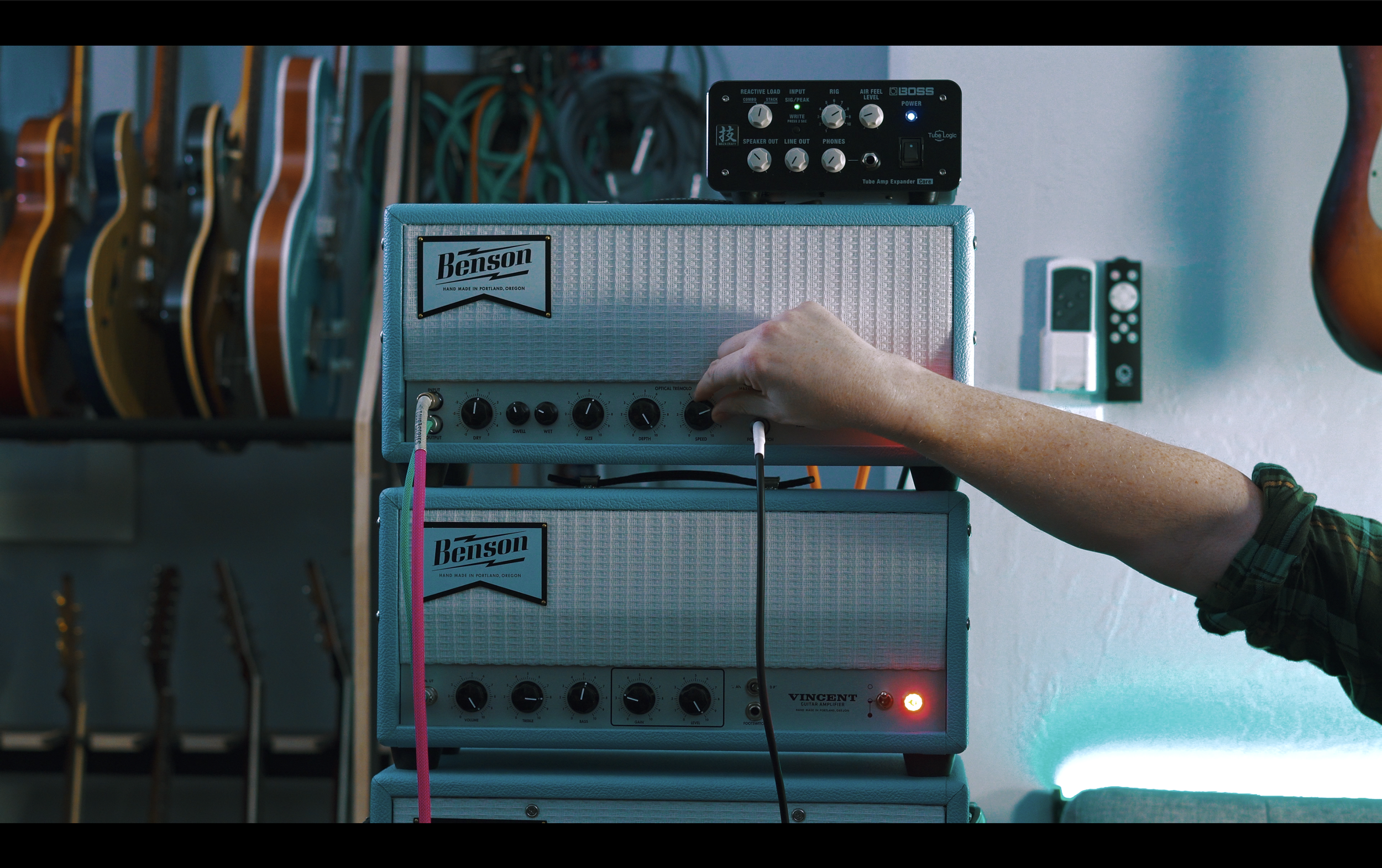

Edge of Breakup
Video Categories
Acorn Amps ADHD
Glitch, filter, bitcrushing, octave, square wave, guitar synth oscillator — disguised as a fuzz pedal. The Acorn Amps ADHD is the most chaotic and most fun pedal I've featured on the channel. Welcome back to Edge of Breakup.
In this episode the Acorn Amplifiers ADHD takes center stage across three guitars — the Giordano Guitars '60s S-Model Strat, the 1967 Gibson ES-335, and the Frank Brothers Ultralight with Lollar El Rayo Humbuckers and Lollar Firebird on a Blender Pot.
ADHD stands for Adaptive Droning Hyperfuzz Device. It works like a two-oscillator synthesizer: one oscillator is your guitar signal converted to a square wave by the fuzz circuit, the other is an adjustable square wave oscillator that can be tuned by hand with the Frequency knob or controlled via external expression pedal. A voltage-controlled timer blends with the gain control of an LM386 amplifier IC chip to produce interactive, layered, bitcrushed octave-up-and-down fuzz tones that can be sculpted further with the Tone/Filter control.
Five knobs run the whole machine. Level handles output. Frequency tunes the internal oscillator — sweep it and the pitch of the synth tone tracks or clashes with your guitar depending on what you're playing, creating everything from locked-in octave doubling to pure noisecore. The pink Balance knob in the center mixes the two oscillators to taste — dialing back the synth side gives you vintage Octavia-style octave fuzz; pushing it to the opposite end and you're in pure square wave chaos. Threshold does the bitcrushing — counterclockwise gives spitty lo-fi gated fuzz, higher settings give full body. Tone adjusts the bandwidth of the fuzz-oscillator interaction.
Three guitars, three completely different tonal personalities through the ADHD. The Giordano single coils, the 335 humbuckers, and the Ultralight's El Rayo/Firebird blend each interact with the oscillator in meaningfully different ways. The Balance knob is the key to making this usable across all contexts.
🎛️ Acorn Amps ADHD: https://www.acornamps.com/gear/adhd-synth-fuzz
🎸 Giordano Guitars: https://www.instagram.com/_giordanoguitars_/
🎸 Frank Brothers Guitars: https://www.frankbrothersguitars.com
🎸 Lollar Pickups: https://www.lollarguitars.com
Subscribe for more boutique tone explorations.
🎸 Giordano Guitars '60s S-Model | Gibson ES-335 | Frank Brothers Ultralight + Lollar El Rayo & Firebird (Blender)
🎛️ Acorn Amps ADHD | Adaptive Droning Hyperfuzz Device | LM386 | Voltage-Controlled Timer | Balance Knob
Fish Circuits Model One
A cult indie builder overdrive that deserves more attention than it gets — and the Frank Brothers Ultralight with Lollar El Rayo humbuckers pushing the Benson Monarch over the edge. Welcome back to Edge of Breakup.
In this episode the Fish Circuits Model One takes center stage — featuring the Frank Brothers Ultralight with Lollar El Rayo Humbuckers and a Lollar Firebird on a Blender Pot, into the Benson Amps Monarch. A full Strat demo covering all modes is coming separately.
The Model One is a natural, amp-like overdrive with three controls and two switches that cover an enormous amount of tonal ground. At lower gain settings it delivers dynamic, amp-like breakup tones that react to the subtleties of your playing. When cranked, you're in saturated fuzzstortion territory with loads of sustain and depth, reminiscent of Orange amps.
The Mode switch is where the character lives — and it's counterintuitive in a useful way. N mode has more volume output but less gain; B mode has more gain but less volume, with saggier, more compressed, almost fuzz-like tones when the Drive is maxed. B mode is the more distorted, clipping-diode engaged mode — compressed and thick. N mode is the open, high-headroom mode — brighter, louder, less compressed, closer to a treble booster character in feel. The two modes are genuinely distinct enough to feel like two different pedals.
The Body switch controls the low-frequency content feeding the drive circuit — three positions: low cut (tighter, more forward), flat, and low boost (biggest and meanest). Combined with the Mode switch and Drive knob, the Model One offers a variety of drive sounds in one compact format, from always-on subtle saturation to full-on raging fuzz territory.
The Frank Brothers Ultralight loaded with Lollar El Rayo Humbuckers and a Lollar Firebird on a Blender Pot is a unique combination — the El Rayo's single-coil-like clarity meets the Firebird's mid-forward bark, blendable on demand. The Benson Monarch on the edge responds beautifully to the Model One's Body and Mode controls.
🎛️ Fish Circuits Model One: https://fishcircuits.com/products/model-one-overdrive
🎸 Lollar El Rayo Humbuckers: https://www.lollarguitars.com
🔊 Benson Amps Monarch: https://www.bensonamps.com/amps/monarch
Subscribe for more boutique tone explorations.
🎸 Frank Brothers Ultralight | Lollar El Rayo Humbuckers + Lollar Firebird (Blender Pot)
🎛️ Fish Circuits Model One | Natural Overdrive | N/B Mode | Body Switch | 3-Position Low Freq
🔊 Benson Amps Monarch
Lauren Audio Mustang
A revisit that was overdue. The Lauren Audio Mustang has earned its reputation as one of the most coveted indie-built preamp pedals available — and my production process has come a long way since the first demo. Welcome back to Edge of Breakup.
In this episode the Lauren Audio Mustang Neve 1073 Preamp Pedal takes center stage — paired with the Giordano Guitars '60s S-Model into the Benson Amps Monarch.
The Neve 1073 is one of the most studied, imitated, and beloved preamp circuits ever built. Designed by Rupert Neve in 1970, it defined the warm, punchy, three-dimensional character of countless classic records. Lauren Audio's James faithfully recreated that circuit in pedal form — and then went further, adding more gain than the original unit is capable of producing along with a variable negative feedback control that puts the harmonic content and breakup entirely in the player's hands.
The Mustang is a Class-A overdrive based on the Neve 1073, supercharged with a modified gain control and variable negative feedback that lets the player control harmonic content and breakup, allowing for a soaring, searing overdrive typically unattainable by its studio brethren. It runs at an internal 24V like the classic Neve rack unit, for incredible headroom and dynamic depth.
Neve 1073-spec BC109C transistors and polystyrene filtering capacitors define the circuit character. A JFET front end provides high-impedance guitar input. The Sensitivity control handles most of the gain and input level — the primary tone-shaping parameter. The Feedback knob controls the variable negative feedback loop: maxed out, you get the most harmonic content, the most breakup, and the closest thing to a fuzz a studio preamp circuit can produce. Rolled back, you get a smooth, pristine preamp character with the warmth and punch of the original console channel strip.
The range covered in this demo — from glassy preamp at 9 o'clock Gain all the way to max Gain and Feedback searing into the Benson Monarch — is genuinely extraordinary.
Pre-order: https://www.lauren.audio/product/mustang-pre-order-1
Subscribe for more boutique tone explorations.
🎸 Giordano Guitars '60s S-Model | Handmade by Nicolas Giordano in Italy
🎛️ Lauren Audio Mustang | Neve 1073 Class-A Preamp | 24V Internal | BC109C | Variable Feedback
🔊 Benson Amps Monarch
Silktone Germanium Fuzz
The most cleverly engineered germanium fuzz pedal ever made. The Silktone Fuzz solves every problem germanium fuzz has had since 1966. Welcome back to Edge of Breakup.
In this episode the Silktone Germanium Fuzz takes center stage — Classic and Raw modes, all across the Bias dial.
The Silktone Fuzz is built around two carefully selected germanium transistors in the classic Fuzz Face topology. But germanium transistors are temperature-sensitive components — which means on every other germanium fuzz pedal, the bias knob setting that sounds perfect at 70°F in your living room will be meaningfully different at 90°F outdoors. You set by ear every time. Silktone's solution: a three-digit LED Active Bias Monitor that shows you the real-time voltage passing through the transistors at all times, regardless of temperature. Dial it to 4.50 for the classic sweet spot. Dial it past 7.50 for fat, sticky fuzz. Dial it to 1.10 for spitty, gated fuzz. Those numbers are repeatable. That is an engineering breakthrough.
The pickup simulator fixes the second chronic problem with germanium fuzz: placement in the signal chain. Most low-impedance fuzzes produce nasty squealing oscillation when any buffered pedal precedes them. The Silktone's internal pickup simulator means it behaves as if a guitar is plugged straight into it regardless of where it sits on your board — before or after wah, overdrive, whatever.
The Cleanup knob is the third innovation. It works in tandem with the pickup simulator by mimicking your guitar volume knob — giving you the full range of fuzz-to-overdrive-to-boost cleanup response without touching your guitar's volume. Set your guitar to full, dial the Cleanup where you want the character to live, and it stays there for the gig.
Classic mode is the traditional Fuzz Face voicing. Raw mode bypasses the Cleanup knob and tone shaping entirely for the full, unimpeded, unfiltered germanium fuzz tone. Two completely different characters from one circuit.
🎛️ Silktone Fuzz: https://www.silktone.org/store/p13/fuzz.html
Subscribe for more boutique tone explorations.
🎛️ Silktone Germanium Fuzz | Active Bias Monitor | Pickup Simulator | Cleanup Knob | Classic + Raw Modes
Walrus Audio Eons Fuzz
Five completely different fuzz circuits in one compact pedal — and a voltage knob that makes each one into ten. The Walrus Audio Eons Five-State Fuzz is the most versatile fuzz pedal I've encountered. Welcome back to Edge of Breakup.
In this episode the Walrus Audio Eons Five-State Fuzz takes center stage — all five modes explored across both the clean and dirt channels.
The Eons is the third in Walrus Audio's Five-States series following the Ages overdrive and the Eras distortion. Same format: five-position mode rotary, five knobs (Volume, Gain, Bass, Treble, and Voltage), compact enclosure. The Voltage knob is the differentiator. Sweep it from 3V to 18V and every mode becomes a different pedal — at 3V you get sputtery, gated, dying-battery fuzz; at 18V you get massive, open, uncompressed fuzz with added low-end and headroom. Every position in between is its own flavor.
Five modes, each built around different clipping configurations:
Mode I — Silicon soft-clipping. Traditional, well-rounded compressed fuzz. Big, smooth, Woodstock-era character.
Mode II — Silicon clipping with bass boost. More compression, more crunch, heft in the low end.
Mode III — Germanium clipping. Crunchy and dynamic — the feel of a fuzz and a distortion combined. The most responsive to playing dynamics and voltage changes.
Mode IV — LED clipping diodes with a slight high-end cut. Dynamically dark. Useful for single-coil pickups or brighter amps where other fuzz modes get brittle.
Mode V — Hard-clipping silicon transistors combined with LED and silicon soft-clipping diodes. The rowdiest of the modes — compressed, loud, and angry.
Active Bass and Treble controls give cut or boost to shape each mode independently — a meaningful addition that most fuzz pedals skip entirely.
🎛️ Walrus Audio Eons Five-State Fuzz: https://www.walrusaudio.com/products/eons-five-state-fuzz
🎸 Frank Brothers Ultra Light | Lollar El Rayo and Firebird | Treble Bleed with the Benson Monarch and Tall Bird, and Boss Waza Tube Amp Expander, actual cabinet mic'd with several mics.
Subscribe for more boutique tone explorations.
🎛️ Walrus Audio Eons | Five-State Fuzz | 5 Clipping Modes | 3V-18V Voltage Control | Active Bass & Treble
Cunningham Amps ZONK MKI Fuzz — Vintage Gibson Guitars ES-335 — Lost in Crystal Canyons
Same pedal as my previous demo, but this time with a 1967 Gibson ES-335. Completely different tonal universe. Welcome back to Edge of Breakup.
This is the second Lost in Crystal Canyons x Cunningham Amps ZONK | MKI demo on the channel — the first featured a Frank Brothers Arcade goldtop with Lollar P90s. Today the 1967 Gibson TV ES-335 goes into the Benson Amps Vincent with Boss Waza Tube Amp Expander for reverb. If you want the full pedal background, the first demo covers it in detail.
The short version: the ZONK | MKI is a collaboration between Robert Hart (Lost in Crystal Canyons — guitar and gear lifestyle photographer) and Tim Cunningham (Cunningham Amps, Auckland, New Zealand). Two fully independent NOS germanium circuits in one solid steel enclosure — a Zonk Machine on the left toggle position, a Tone Bender MKI on the right — each built to Tim's exacting hand-matched standard. Two knobs: Fuzz (left, gain) and Level (right, output). One battery kill switch. Single-digit production drops.
What the ES-335 brings to this pairing that the P90-loaded goldtop doesn't: the humbuckers and semi-hollow construction push a rounder, thicker low-end into both circuits, making the Zonk Machine warmer and the Tone Bender MKI's bark more mid-forward. The neck pickup on the 335 into the Zonk at high Fuzz is an entirely different animal than a P90 bridge. The guitar volume cleanup is extraordinary — the 335's humbuckers respond to the NOS germanium transistors in a way that rewards slow, deliberate volume knob work.
First demo (Frank Brothers Arcade): https://www.youtube.com/watch?v=w_CSIo9B5i8
Robert Hart: https://www.instagram.com/lostincrystalcanyons/
Tim Cunningham: https://www.instagram.com/cunninghamamps/
🔊 Benson Amps Vincent: https://www.bensonamps.com/amps/vincent
Subscribe for more boutique tone explorations.
🎸 1967 Gibson TV ES-335
🎛️ Lost in Crystal Canyons x Cunningham Amps ZONK | MKI | NOS Germanium | Zonk Machine + Tone Bender MKI
🔊 Benson Amps Vincent
Recording: Royer R121 & SM57 on cab | Royer R10 on room
Jam Pedals Retrovibe
Two NOS germanium circuits — a Dallas Rangemaster and a vintage-spec Uni-Vibe — running into a pushed Benson Monarch. This is a visceral tonal experience. Welcome back to Edge of Breakup.
In this episode the JAM Pedals RetroVibe pairs with the R2R Electric R2RGeMaster Treble Booster (@djlavalamp) — running into my Nash S63 Stratocaster with Lollar Vintage Blonde neck and middle, Lollar Special Strat bridge, Emerson Custom 4-Way Wiring Kit and Treble Bleed, into my Benson Amps Monarch and Benson 2x12" cabinet.
The RetroVibe is comprised of photocells, a bulb, original NOS 2SC828 transistors and carbon comp resistors — the same transistors used in the 1969 Uni-Vibe. 9V DC operation, internally lifted to 15V DC. Handmade in Athens, Greece.
Two controls on the face: Depth sets the intensity of the modulation, from subtle shimmer to deep pulsating throb. Speed navigates from slow-rate oceanic swells all the way to fast Leslie-speaker rotary impersonations. A toggle switches between Chorus and Vibrato modes. An internal trimmer adjusts maximum effect intensity and also dramatically shapes the character of the effect — not just a ceiling, but a voice control. Expression pedal input for real-time Speed control via standard passive 10k and TRS cable. Four photocells surrounding a pulsating light source deliver the thick, swirling beauty of vintage chorus and vibrato in all its analog complexity.
The R2RGeMaster enters the chain as a germanium treble booster — Philips/Mullard AC107 black glass transistors, Dallas Rangemaster circuit, 6-position NOS input capacitor switch — cleaning up beautifully via the guitar volume knob and giving the RetroVibe a glassy, focused signal to work with. The interaction between germanium boost and NOS Uni-Vibe circuit is exactly what you'd hope for.
🎛️ JAM Pedals RetroVibe: https://www.jampedals.com/retrovibe/
🎛️ R2R Electric R2RGeMaster: https://www.r2relectric.com/how-to-order
🎸 Nash Guitars S63: https://nashguitarsusa.com
🎸 Lollar Pickups: https://www.lollarguitars.com
🔧 Emerson Custom 4-Way: https://emersoncustom.com
🔊 Benson Amps Monarch: https://www.bensonamps.com/amps/monarch
Subscribe for more boutique tone explorations.
🎸 Nash S63 | Lollar Vintage Blonde (Neck & Middle) + Special Bridge | Emerson Custom 4-Way + Treble Bleed
🎛️ JAM Pedals RetroVibe | NOS 2SC828 | Photocell Uni-Vibe | Chorus + Vibrato
🎛️ R2R Electric R2RGeMaster | NOS AC107 | 6-Position Capacitor Switch
🔊 Benson Amps Monarch | Benson 2x12" Cabinet
Recording: Royer R121 & SM57 on grille | Royer R10 on back off-axis
Browne Amplification Carbon Overdrive
One of my favorite overdrives of all time. The Browne Amplification Carbon is a deceptively simple three-knob pedal that hides an enormous tonal range in every position of every knob. Welcome back to Edge of Breakup.
In this episode the Browne Amplification Carbon Overdrive takes center stage — running into my Nash T63 Telecaster with Lollar Vintage Neck and Special Bridge, Emerson Custom 4-Way Wiring Kit and Treble Bleed, into my Benson Amps Monarch and Benson 2x12" cabinet.
The Carbon is a standalone version of the "Blue" channel of Browne Amplification's celebrated Protein Dual Overdrive — a heavily modified Bluesbreaker-inspired circuit that has been painstakingly refined to address some of the issues commonly associated with the 1990s Marshall Bluesbreaker, while maintaining the open, amp-like feel that made the original circuit famous. The circuit was inspired by a legendary voicing favored by John Mayer on the Continuum album.
Three controls: Volume, Gain, and Tone. The higher the gain is set, the brighter the timbre of the pedal will be. This relationship between Gain and Tone is the key to the Carbon's character — they're in constant conversation. High Gain with Tone rolled back gives you a full, mid-forward drive that sits beautifully in a band mix. Low Gain with Tone maxed opens up the top end for a bright, clear presence. Pull Gain back and push Level past unity and the Carbon becomes a pure amp enhancer — slamming your front end with level, EQ, and JFET character while keeping the overdrive character entirely from the amp's preamp.
The Carbon absolutely excels as an always-on enhancer for a clean amp — the luscious lower mids and singing top end are there even at low gain settings, reshaping the feel and response of whatever amp it's in front of. A Telecaster into a pushed Benson Monarch with this pedal as the EQ and gain stage is as good as it sounds.
🎛️ Browne Amplification Carbon: https://browneamps.com/thecarbon
🎸 Nash Guitars T63: https://nashguitarsusa.com
🎸 Lollar Pickups: https://www.lollarguitars.com
🔧 Emerson Custom 4-Way Kit: https://emersoncustom.com
🔊 Benson Amps Monarch: https://www.bensonamps.com/amps/monarch
Subscribe for more boutique tone explorations.
🎸 Nash T63 Telecaster | Lollar Vintage Neck + Special Bridge | Emerson Custom 4-Way + Treble Bleed
🎛️ Browne Amplification Carbon | Bluesbreaker-Inspired Overdrive | 3 Knobs
🔊 Benson Amps Monarch | Benson 2x12" Cabinet
Recording: Royer R121 & SM57 on grille | Royer R10 on back off-axis | Universal Audio Apollo x4
Catalinbread Belle Epoch Deluxe
The Echoplex EP-3 is one of the most coveted tape echo units in history. The Catalinbread Belle Epoch Deluxe is the closest a pedal has ever come to putting one on your board — and then it keeps going. Welcome back to Edge of Breakup.
In this episode the Catalinbread Belle Epoch Deluxe takes center stage — running into my Prisma Guitars Sunset with Lollar Gold Foil pickups, into my Benson Amps Vincent.
The Maestro Echoplex EP-3 was the tape echo of the 1970s. David Gilmour, Jimmy Page, Eddie Van Halen — the EP-3 defined the sound of electric guitar through the period as much as any amp. Players have chased its preamp as much as its echo: the JFET preamp, mixer stage, and high-gain silicon transistor record and playback amplifiers impart a warmth, openness, and three-dimensional quality to every signal that passes through, even with no echo engaged.
The Belle Epoch Deluxe reproduces that signal chain component by component. The 9V DC power is converted to 22V internal rails via a voltage tripler — exact to the original EP-3 spec. A 24-bit high-fidelity digital delay line replaces the tape cartridge. Every other stage is analog and faithful to the original.
Six echo programs expand the EP-3 foundation significantly:
Mode 1 — Classic EP-3 Echoplex. The original tape echo character, wow and flutter included, with that JFET preamp coloring everything.
Mode 2 — Analog/BBD-voiced delay. Warmer, darker, with a subtle chorus quality on the repeats.
Mode 3 — Roto Swirl. The delay signal passes through a rotary cabinet simulation. Expression pedal controls rotary speed.
Mode 4 — Resonant Filter Sweep. The repeats are swept through a resonant filter, manually or via expression pedal.
Mode 5 — DMM Chorus (Deluxe Memory Man-voiced).
Mode 6 — DMM Vibrato.
A second footswitch triggers momentary self-oscillation, tunable via internal trimpot. Expression pedal — sold separately, used here with a newly acquired Catalinbread tap switch — controls delay time, echo volume, rotary speed, or filter sweep depending on the program.
🎛️ Catalinbread Belle Epoch Deluxe: https://catalinbread.com/products/belle-epoch-deluxe
🎸 Prisma Guitars Sunset: https://www.prismaguitars.com/collections
🎸 Lollar Gold Foil Pickups: https://www.lollarguitars.com/gold-foil
🔊 Benson Amps Vincent: https://www.bensonamps.com/amps/vincent
Subscribe for more boutique tone explorations.
🎸 Prisma Guitars Sunset | Lollar Gold Foil Pickups
🎛️ Catalinbread Belle Epoch Deluxe | Echoplex EP-3 | 6 Echo Programs | JFET Preamp | 22V Rail
🔊 Benson Amps Vincent
Total Gravy Guitarworks | Early PAF Humbuckers
Episode 5 of the Gibson SG Humbucker Hunt — and this time it's Total Gravy Guitarworks out of Fullerton, California. Welcome back to Edge of Breakup.
Total Gravy Guitarworks Early PAF set: https://www.totalgravy.com/store/p8/Early_P.A.F._Set.html
The hunt so far:
Ep. 1 — Stock Gibson Burstbuckers: https://youtu.be/xcC6wLci1DY
Ep. 2 — Seymour Duncan Antiquities: https://youtu.be/ntlHT09FXxA
Ep. 3 — Fralin Pure PAF: https://youtu.be/lPHmESPyyxs
Ep. 4 — Lollar El Rayo: https://youtu.be/RoC8PYLQI6c
Total Gravy Guitarworks was started in 2015 by Derek with a single mission: recreate the classic vintage pickup tones that inspired players to pick up the guitar in the first place. Every pickup is handmade to order in Fullerton, CA using period-correct materials and NOS coil wire. The Early PAF targets the character of the 1957-1959 Patent Applied For humbuckers — the original Seth Lover design, pre-wax-potted, scatter-wound on Leesona machines, with unevenly wound coils that produced the complex harmonic response and open top end that defines the PAF sound.
The Gibson SG Standard '61 Reissue has been substantially modified from stock. StewMac Locking Kluson tuners and a StewMac bone nut addressed the tuning stability. Emerson Custom SG Wiring Kit throughout, with Emerson Custom Treble Bleed on both volume knobs to preserve top end during volume cleanup. TonePros ABR-1 replacement saddle with nylon saddles replaces the original stop tail hardware.
The R2R Electric R2RGeMaster Treble Booster (@djlavalamp) joins from chapter 5 — NOS Philips/Mullard AC107 germanium transistors, Dallas Rangemaster circuit, 6-position NOS input capacitor switch, running into the Benson Amps Monarch.
🎸 Total Gravy Guitarworks: https://www.totalgravy.com
🔊 Benson Amps Monarch: https://www.bensonamps.com/amps/monarch
🎛️ R2R Electric R2RGeMaster: https://www.r2relectric.com
Subscribe for more boutique tone explorations.
🎸 Gibson SG Standard '61 Reissue | Total Gravy Guitarworks Early PAF Set | Emerson Custom Wiring
🎛️ R2R Electric R2RGeMaster | NOS AC107 | 6-Position Capacitor Switch
🔊 Benson Amps Monarch
Giordano Guitars '60s S-Model
The finest single-coil guitar I've ever played — and it's handmade in Italy by one person. Welcome back to Edge of Breakup.
Today is the debut of the Giordano Guitars '60s S-Model, which is now my flagship Stratocaster-style guitar on the channel. Nicolas Giordano builds every guitar himself in Italy, obsessing over every detail until the instrument is exactly right. The result is something genuinely special — a '60s-voiced S-type that captures the bell-like clarity, quack, and bloom of the great pre-CBS Stratocasters without any of the compromises of a production instrument.
The '60s S-Model features a Blender Pot modification — a circuit addition that blends a selected secondary pickup into any pickup position, allowing combinations not available on the standard 5-way switch. In this video you'll hear the Blender Pot activated across multiple pickup positions including bridge-into-neck-middle — a combination that produces a full, complex, almost Telecaster-like character unique to the blended configuration.
The amp is my Benson Amps Monarch — all the way from clean and pushed on 7 to fully cranked on 10, covering the full range of what this guitar wants to do. Halfway through, the R2R Electric R2RGeMaster Treble Booster (built by Chris Vincent, aka @djlavalamp) enters the signal chain, transforming the Monarch's clean headroom into the singing, scrape-and-bloom NOS germanium character that makes a great single-coil guitar reveal everything it has.
DM Nicolas on Instagram to start your build: https://www.instagram.com/_giordanoguitars_/
🔊 Benson Amps Monarch: https://www.bensonamps.com/amps/monarch
🎛️ R2R Electric R2RGeMaster: https://www.r2relectric.com/how-to-order
Subscribe for more boutique tone explorations.
🎸 Giordano Guitars '60s S-Model | Handmade by Nicolas Giordano in Italy | Blender Pot
🎛️ R2R Electric R2RGeMaster Treble Booster | NOS Germanium
🔊 Benson Amps Monarch
Other R2R Electric videos you might like:
https://www.edgeofbreakup.studio/latest-videos/the-best-nos-fuzz-face-r2r-electric-geface-deluxe
https://www.edgeofbreakup.studio/latest-videos/r2r-electric-uniform-fuzz
https://www.edgeofbreakup.studio/latest-videos/electric-machine-fuzz-r2r-electric-zonk-machine
https://www.edgeofbreakup.studio/latest-videos/1959-fender-tweed-deluxe-5e3-vintage-amp-showcase
https://www.edgeofbreakup.studio/latest-videos/r2r-electric-pkiii-fuzz
https://www.edgeofbreakup.studio/latest-videos/r2r-electric-mki-pro-fuzz
https://www.edgeofbreakup.studio/latest-videos/r2r-electric-pre-amp-vintage-wah
Acorn Amps Bweep Fuzz
The world's smallest Fuzz Face-style pedal — and one of the best. The Acorn Amps BWEEP takes up 2 square inches on your board and sounds like nothing that small has any right to. Welcome back to Edge of Breakup.
In this episode the Acorn Amps BWEEP Mini Fuzz takes center stage. This is Acorn's follow-up to their groundbreaking Solid State amp-in-a-pedal, and they've applied the same philosophy: maximum tone, minimum footprint.
The BWEEP is a modded Fuzz Face circuit crammed into a thick diecast aluminum enclosure assembled with Lumberg jacks and a robust latching footswitch. Two controls: Volume and Fuzz. That's it. Which is exactly all you need when a pedal is this responsive to your guitar's volume and tone controls and pickup selection. Roll back your guitar volume and the BWEEP cleans up beautifully — from full singing fuzz sustain all the way back to gritty boost territory in one smooth sweep. Pickup switching adds another dimension of tonal variation without touching a single knob on the pedal.
The Fuzz control sweeps from gritty boost tones through aggressive crunch and into thick, singing lead sustain. Volume provides plenty of output to push your amp as hard as you want. 9VDC powered, less than 10mA current draw. The entire enclosure is smaller than a TC PolyTune or a tap tempo switch.
Note: The BWEEP is now discontinued from Acorn Amps. If you want a sonically similar circuit, Acorn points to their current lineup. Grab a used BWEEP while you can.
🎛️ Acorn Amps: https://www.acornamps.com
🎛️ Acorn Solid State (amp-in-a-pedal): https://www.acornamps.com/gear/solid-state-amppreamp-pedal
Subscribe for more boutique tone explorations.
🎛️ Acorn Amps BWEEP Mini Fuzz | Modded Fuzz Face | 2 Square Inches | Atlanta, Georgia
Dominion Electric Dominion Fuzz
Germanium or silicon? For the first time, you don't have to choose. The Dominion Electric Dominion Fuzz puts both circuits in one enclosure and lets you switch between them on the fly. Welcome back to Edge of Breakup.
In this episode the Dominion Electric Dominion Fuzz takes center stage. Guitar and rig details in the chapters — this description is about what makes this pedal genuinely different.
The Dominion Fuzz is Aaron's take on the classic Fuzz Face circuit, built one at a time in Canada with NOS Allen-Bradley carbon composition resistors, Wima capacitors, a 2oz copper trace PCB with gold pads, and two fully independent circuits — one NOS germanium, one NOS silicon — each with its own set of internal trimmers.
The germanium/silicon toggle is the headline feature. Both circuits are independently tunable via internal trimmers: a Bias control that tailors the character of the fuzz, and a Pre-Gain control that functions like your guitar's volume knob to clean up the circuit at rest. Set both to taste, save them, and switch between them live with a flick of the top-side switch. For players who gig in variable temperatures — where germanium's sensitivity to heat can cause unpredictable behavior — the silicon circuit is a fully dialed-in backup, not an afterthought. And the silicon circuit here earns its place on merit: extraordinary attack and the most musical treble-bleed cleanup of any silicon fuzz circuit I've played.
The fuzz control's sweep has been deliberately redesigned. Most Fuzz Face-style circuits have a fuzz knob that's either on or off — everything useful happens in the last 10% of the sweep. Aaron reworked the gain span to open up the full range of the knob, making every position sonically useful and giving players access to the micro-climates of fuzz gain that define the character of this style of circuit.
Two face controls: Level and Fuzz. Clean, pedalboard-friendly enclosure with top jacks. Gorva soft-click footswitch. Handmade — small variances in finish between units. Visual design by Thierry L'Écuyer.
🎛️ Dominion Electric Dominion Fuzz: https://dominionelectric.co/products/dominion-fuzz-white
Subscribe for more boutique tone explorations.
🎛️ Dominion Electric Dominion Fuzz | NOS Germanium + Silicon | Dual Independent Circuits | Made in Canada
Walrus Audio Mira Compressor
Compressors have a reputation problem on guitar boards. Too squashy, too transparent, too easy to set wrong and ruin your dynamics. The Walrus Audio Mira is the compressor that brought me back. Welcome back to Edge of Breakup.
In this episode the Walrus Audio Mira Optical Compressor gets its first impressions demo — alongside the debut of my brand new Giordano Guitars '60s S-Model, handmade by Nicolas Giordano in Italy. The finest single-coil guitar I've ever played.
The Mira is an analog optical compressor with studio-grade controls in a pedalboard enclosure, running internally at ±15V DC for increased headroom. Seven knobs and one side-chain switch cover every parameter you'd find on a professional studio compressor.
Threshold sets where compression begins based on input level. Ratio controls the amount of gain reduction above that threshold. Attack determines how fast the compressor engages after the signal crosses the threshold — slow attack lets the initial transient through before squashing, which keeps your pick attack alive. Release controls how quickly the compressor lets go after the signal drops below threshold — longer release creates singing, sustained notes. Make-Up compensates for volume lost through compression, maintaining unity or adding boost. Level controls overall output.
The Blend knob is what makes the Mira genuinely useful for guitar: at fully counter-clockwise you're running pure dry signal, at fully clockwise you're fully compressed with no dry. Parallel compression — blending a small amount of heavily compressed signal with your clean tone — is how studio engineers get sustain and clarity simultaneously without the squashed quality that makes aggressive compression feel wrong under a guitar. The Mira makes that technique trivially easy.
The Sidechain High-Pass Filter button removes frequencies below 120Hz from triggering the compressor. On guitar, this means your low strings and low-mid body don't over-trigger the compression, keeping low-end dynamics natural while the high-mids and treble get the sustain treatment. A gain-reduction LED provides visual feedback on how hard the compressor is working.
🎛️ Walrus Audio Mira: https://www.walrusaudio.com/products/mira-optical-compressor
🎸 Giordano Guitars: https://www.instagram.com/_giordanoguitars_/
Subscribe for more boutique tone explorations.
🎸 Giordano Guitars '60s S-Model (Debut) | Handmade in Italy by Nicolas Giordano
🎛️ Walrus Audio Mira | Analog Optical Compressor | ±15V | 7 Controls | HPF Sidechain
P90 Tone from a Plugin?! Benson Chimera Collection Plugin & Frank Brothers Arcade (Mixwave)
Download my 16 free Edge of Breakup presets for the Benson Amps Chimera Collection plugins here: https://www.dropbox.com/s/6kiapwgesh3ne51/Benson%20Mixwave%20Chimera%20Plugins%20-%20Edge%20of%20Breakup%20Presets.zip?dl=0
I don't say this lightly: the Benson Amps x MixWave Chimera Collection plugins are the best guitar plugins I've ever played. Welcome back to Edge of Breakup.
This is a rare departure from the channel's usual real mic'd cab recordings. No IR, no virtual amp emulation in any other video — but the Benson Chimera Collection earned an exception.
Here's why. I own a Benson Vincent 2x12", a Monarch head, an Earhart Head and 1x12", a Vinny Reverb Combo, the original Vinny with 1x10", and a Tall Bird. I know what Benson amps sound like better than almost anyone outside of Portland. This plugin does the Benson thing. Chris Benson himself has stated publicly that he was fooled during a listening comparison between the plugin and the real amp. That's the standard.
The Chimera Collection is a component-modeled plugin suite covering Benson's complete signal chain: Germanium Boost, Germanium Fuzz, Preamp, the Chimera Amplifier itself, and the Tall Bird Spring Reverb. The cabinet module features the vertical dove-tailed pine Chimera 2x12" with Benson Custom Ceramic and Celestion G12H30 Anniversary speaker options, paired with 20 virtual microphones and over 240 impulse responses. Every component can be rearranged in signal chain order. Built on Kontakt Player, available as VST3, AU, AAX, and standalone.
In this video: Frank Brothers Arcade with Lollar '50s Wind P90s and Emerson Custom Treble Bleed, direct into the plugin. Five presets from my pack: Bridge Growl, Huge Fuzz, On the Edge, Sweet with a Bit of Gain, and Tubey. All 16 presets in the download cover Strat, Tele, 335, and P90 contexts.
Plugin: https://mixwave.com/products/benson-chimera-collection
Subscribe for more boutique tone explorations.
🎸 Frank Brothers Arcade | Lollar '50s Wind P90 Pickups | Emerson Custom Treble Bleed
🎛️ Benson Amps x MixWave Chimera Collection Plugin
Note: This video is a rare direct/plugin exception — all other Edge of Breakup videos are real mic'd cab, no IR, no digital.
Cunningham Amps MK1.6 (Texas Instruments 2N404 Germanium Transistors)
The missing link between two of the greatest fuzz circuits ever made — built by hand in New Zealand. Welcome back to Edge of Breakup.
In this episode the Cunningham Amps MK 1.6 Germanium Fuzz takes center stage — running into my Benson Amps Monarch with NOS Tung Sol tubes, with the Benson Tall Bird running in the Boss Waza Tube Amp Expander effects loop for tube reverb, through my Nash S63 Stratocaster with Lollar Vintage Blonde neck and middle, Lollar Special Strat bridge, and Emerson Custom Treble Bleed.
The MK 1.6 is Tim Cunningham's deeply considered bridge between two mid-1960s legends. The Dallas Arbiter Fuzz Face — two transistors, four resistors, the most intimate and touch-sensitive fuzz circuit ever built — defined one end of the classic British fuzz spectrum. The Sola Sound Tone Bender MK 1.5 — the evolutionary predecessor to the MKII, with a booster gain stage driving the fuzz — defined the other. The MK 1.6 sits in the fertile territory between them: the germanium warmth and extraordinary cleanup response of a Fuzz Face combined with the searing, ripping bark of the MK 1.5 Tone Bender.
Built on a hand-etched board with premium components throughout, the MK 1.6 is individually voiced to its specific pair of transistors — these are NOS Texas Instruments 2N404 germanium devices, and no two MK 1.6 pedals are exactly alike. Each is hand-built by Tim Cunningham one at a time in Auckland, New Zealand. Battery powered only, with an on/off switch that disconnects the battery from the circuit when a cable is plugged in — safe to leave wired on your board.
Controls are Attack (fuzz gain, from subtle crunch to full searing saturation) and Level (overall output, with significant headroom to slam your amp). Cleaning up from your guitar's volume knob is the primary expressive tool — the germanium circuit responds to guitar volume in a way no modern fuzz can replicate. The three gain modes explored in this demo reveal how different the MK 1.6's personality becomes across its range.
Every pedal ships with a handmade padded carry bag, signed and numbered certificate of authenticity, and instruction card.
🎛️ Cunningham Amps MK 1.6: https://www.cunninghamamps.co.nz/product-page/mk-1-6-fuzz-olive-drab-pre-order
🎸 Nash Guitars S63: https://nashguitarsusa.com
🎸 Lollar Vintage Blonde & Special Strat: https://www.lollarguitars.com
🔊 Benson Amps Monarch: https://www.bensonamps.com/amps/monarch
Subscribe for more boutique tone explorations.
🎸 Nash S63 | Lollar Vintage Blonde (Neck & Middle) + Special Bridge | Emerson Custom Treble Bleed
🎛️ Cunningham Amps MK 1.6 Germanium Fuzz | NOS TI 2N404 | Hand-Built New Zealand
🔊 Benson Amps Monarch (NOS Tung Sol) | Boss Waza TAE | Benson Tall Bird
J Rockett Audio El Hombre Overdrive
Texas Blues guitar tone for days. The J. Rockett Audio Designs El Hombre is a three-knob overdrive with a deceptively wide range — and it earns every inch of it. Welcome back to Edge of Breakup.
In this episode the J. Rockett El Hombre takes center stage, running into my Nash S63 Stratocaster with Lollar Vintage Blonde neck and middle, Lollar Special Strat bridge, Emerson Custom Treble Bleed, and KingTone Switch, into my Benson Amps Vincent 2x12" cab.
The El Hombre's origin: J. Rockett was deep in the early ZZ Top catalog — First Album, Tres Hombres, Fandango — when the circuit came together. The bearded Texas legend in the name is Billy Gibbons, and the pedal captures the warm, dynamic, slightly fuzzy overdrive character that defines his classic tone. Three knobs, enormous range.
Gain controls the drive level — and the El Hombre spans it honestly, from clean-ish blues crunch to wide open rock saturation. Volume handles output. The Bite control is the voice engine: clockwise gets increasingly aggressive, forward and biting — think Plexi-style attack. Counter-clockwise gets smoother, warmer, and more reminiscent of Dumble-style creamy saturation. The interaction between Gain and Bite creates a genuinely unusual range of overdrive characters from three simple knobs.
The inversion trick is key: push Volume high and pull Gain back, and the El Hombre becomes a preamp — slamming the front end of the amp with level rather than clipping. Pull Gain and drop Volume for the smooth Carlton/Ford sound. The El Hombre is designed to behave like a real amp, not a circuit, and in that it largely succeeds.
Guitar World reviewed it as "a tribute to Billy Gibbons with flexibility that lends itself to many styles beyond Texas blues and boogie." That's accurate — the Bite knob alone spans enough territory that it's a different pedal in different positions.
🎛️ J. Rockett Audio El Hombre: https://rockettpedals.com/el-hombre/
🎸 Nash Guitars S63: https://nashguitarsusa.com
🎸 Lollar Vintage Blonde & Special Strat: https://www.lollarguitars.com
🔧 Emerson Custom Treble Bleed: https://emersoncustom.com
🔊 Benson Amps Vincent: https://www.bensonamps.com/amps/vincent
Subscribe for more boutique tone explorations.
🎸 Nash S63 | Lollar Vintage Blonde (Neck & Middle) + Special Bridge | Emerson Treble Bleed | KingTone Switch
🎛️ J. Rockett Audio Designs El Hombre | Texas Blues Overdrive
🔊 Benson Amps Vincent 2x12"
Catalinbread Tribute | Parametric EQ Overdrive
What is a parametric EQ overdrive and why should you care? The Catalinbread Tribute answers both questions simultaneously. Welcome back to Edge of Breakup.
In this episode the Catalinbread Tribute Parametric Overdrive takes center stage — running into my Frank Brothers Arcade with Lollar Pickups '50s Wind P90s, into my Benson Amps Vincent 2x12" cab.
Most overdrives have a fixed EQ voice baked in by the designer. The Tribute gives that decision to the player instead. Four knobs: Vol (output), Drive (gain), Freq, and Tone — the last two working in tandem to form a supercharged one-band parametric EQ based on Catalinbread founder Nicholas Harris's original VariOboost circuit.
Here's how it works: The Freq knob selects any frequency between 70Hz and 1.4kHz — the entire useful guitar frequency range, from deep lows through upper midrange. The Tone knob then boosts or cuts that exact frequency by up to ±12dB. Tone clicks to a center detent at noon, which is flat — nothing boosted or cut regardless of Freq position. Want thick, spongy low mids? Set Freq to 200-300Hz and boost with Tone. Want that exact presence frequency where your guitar suddenly cuts through a band mix? Find it with Freq, boost with Tone. Want to dial out the nasal honk of your neck P90? Find it and cut it. Same pedal, infinite voices.
The Drive knob controls two parameters simultaneously via a dual-gang pot: clean blend and overdrive gain together. At minimum Drive, you get a pristinely buffered, clean signal — a cocked-wah filter for your clean tone. At maximum, full gain with no dry signal. Anywhere in between is a carefully calibrated clean-drive blend. High headroom throughout.
Premier Guitar called it "powerful but simple" and noted it can replicate Klon-style, TS-style, and SD-1-style midrange voicings with ease — not because it's copying those circuits, but because the parametric EQ unlocks the same frequency emphases that distinguish them.
🎛️ Catalinbread Tribute: https://catalinbread.com/products/tribute
🎸 Frank Brothers Arcade + Lollar '50s Wind P90s
🔊 Benson Amps Vincent: https://www.bensonamps.com/amps/vincent
Subscribe for more boutique tone explorations.
🎸 Frank Brothers Arcade | Lollar '50s Wind P90 Pickups
🎛️ Catalinbread Tribute | Parametric EQ Overdrive | VariOboost | ±12dB | 70Hz-1.4kHz
🔊 Benson Amps Vincent 2x12"
Walrus Audio Slotva
The best ambient reverb I've ever experienced — in a full band mix. That's the test that matters. Welcome back to Edge of Breakup.
This is the Walrus Audio Slötvå's second appearance on the channel — the solo demo is here if you missed it: https://youtu.be/uNhDonLO5Mo
In this episode I'm pairing the Slötvå with a new guitar — the Prisma Guitars Dillinger, Prisma's first baritone model. Hard rock maple skateboard top over a semi-hollow alder body, with a Mastery Trem and Bridge. Into the Benson Amps Vincent clean and dirt channels.
The question this video answers is whether ambient reverb survives a band context. The common experience is that reverb, particularly deep modulated reverb, disappears into the mix when drums and bass arrive — pushed into the background, fighting for space it can't win. The Slötvå behaves differently. The three-dimensional, constantly shifting character of all three modes — Dark, Rise, and Dream — cuts through a dense mix without sitting on top of it. The reverb becomes part of the ensemble texture rather than a wash behind the guitar.
Dark mode: -1 octave signal feeding the reverb trail, creating deep, wide atmospheric weight beneath the guitar. Rise mode: auto-swell reverb that blooms in from below after each note — in a band mix, the swell becomes a compositional element that fills space between notes rather than competing with other instruments. Dream mode with its latching Sustain function: press once to hold the current reverb indefinitely, play over it, press again to release. In a full band context this is a keyboard pad substitute that responds to what's already happening in the room.
The Prisma Guitars Dillinger is everything you'd expect from Nick Pourfard's approach — reclaimed hard rock maple skateboard laminate producing a visually and sonically distinct instrument, with the Mastery Bridge and Trem for precise intonation and feel.
🎛️ Walrus Audio Slötvå: https://www.walrusaudio.com/products/slotva-multi-texture-reverb
🎸 Prisma Guitars: https://www.prismaguitars.com/collections
🔊 Benson Amps Vincent: https://www.bensonamps.com/amps/vincent
Subscribe for more boutique tone explorations.
🎸 Prisma Guitars Dillinger Baritone | Hard Rock Maple Skateboard Top | Mastery Bridge & Trem
🎛️ Walrus Audio Slötvå | Dark / Rise / Dream
🔊 Benson Amps Vincent
Recording: Universal Audio Apollo x4 | Royer R121 & R10 + SM57 on cab | Ableton Live 11
Spaceman Effects Explorer Analog Phaser
Spaceman Effects brought their classic Explorer phaser back in a smaller enclosure and somehow gave it more features, not fewer. Welcome back to Edge of Breakup.
In this episode the Spaceman Effects Explorer 6-Stage Analog Phaser takes center stage — running straight into the front of my Benson Amps Vincent 2x12" cab with my Prisma Guitars Sunset loaded with Lollar Gold Foil pickups, across clean, pushed, and dirty tones.
Named after Explorer 1 — the first satellite the United States put into orbit in 1958, and the first circuit Spaceman ever launched — the Explorer is an optical, photocell-based 6-stage analog phaser. Hand-wired and built in Portland, Oregon, in a compact cast-aluminum enclosure with engraved vinyl faceplate, true-bypass relay switching, and soft-touch footswitch. 9-24V capable for high headroom applications.
Six knobs, each with a specific purpose. VOL sets output level. MIX blends dry signal — at 100% wet the MIX control shifts into pitch modulation mode. RES adds feedback for over-the-top, resonant phase tones. RANGE controls the low frequency extension of the phasing — at low settings only high frequencies are phased (vibrato and rotary speaker territory); cranked, the phaser extends deep into low frequencies for slow, cavernous sweeps. RATE spans from glacially slow to extremely fast. SHAPE selects five LFO waveforms: Sine, Ramp Down, Ramp Up, Triangle, and Square — plus a sixth Manual position that disconnects the LFO entirely and freezes the phase sweep, turning the RATE knob into a manual frequency control.
The CV/EXP input is the performance secret: in LFO modes it controls speed in real time; in Manual mode it sweeps the phaser directly, essentially turning the Explorer into a wah-style phase sweeper when combined with the Resonance control.
This is the balance Spaceman consistently gets right — comprehensive enough for deep exploration, coherent enough to dial in quickly. Exceptional work.
🎛️ Spaceman Effects Explorer: https://spacemaneffects.com/products/explorer
🎸 Prisma Guitars Sunset: https://www.prismaguitars.com/collections
🎸 Lollar Gold Foil Pickups: https://www.lollarguitars.com/gold-foil
🔊 Benson Amps Vincent: https://www.bensonamps.com/amps/vincent
Subscribe for more boutique tone explorations.
🎸 Prisma Guitars Sunset | Lollar Gold Foil Pickups
🎛️ Spaceman Effects Explorer | 6-Stage Optical Phaser | 5 Wave Shapes | CV/EXP
🔊 Benson Amps Vincent 2x12"